5CO01 Organisational Performance and Culture in Practice: Complete Study Guide
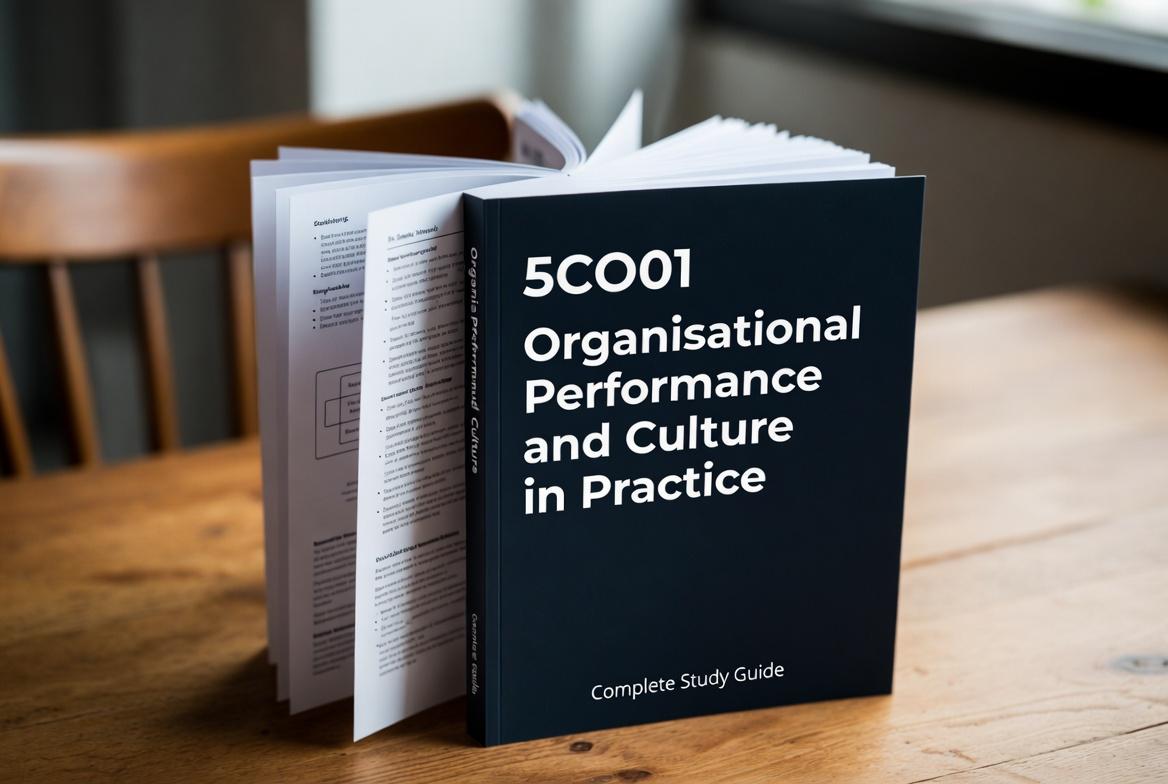
5CO01 Organisational Performance and Culture in Practice is one of three core units in the CIPD Level 5 Associate Diploma in People Management. Worth 7 credits (the largest of the core units), it examines how organisational structure, culture, and the external environment connect to create business performance—and how people practice sits at the heart of this.
This guide breaks down everything you need to understand about 5CO01, including the key models, what each assessment criterion is asking for, and how to approach your assignment effectively.
Free Video Explainers: People Study Pro members get free access to video explanations of Kotter's 8-Step Model, Lewin's Change Model, Kübler-Ross Change Curve, Schein's Culture Model, Handy's Culture Types, and more. Sign up free →
What You'll Learn in 5CO01
The unit covers three main learning outcomes:
- Understand the connections between organisational structure, strategy and the business operating environment — How different structures work, how strategy connects to products and customers, how external factors shape priorities, and the role of technology.
- Understand organisational culture and theoretical perspectives on how people behave at work — Culture models, management and leadership impact, change management approaches, how people experience change, and employee wellbeing.
- Understand how people practice supports the achievement of business goals and objectives — The employee lifecycle, how HR/L&D connects to wider strategy, and consulting with internal customers.
Key Models and Theories for 5CO01
Your assignment will require you to apply relevant theoretical frameworks. Here are the main ones you'll need:
For Organisational Structure (LO1)
Functional structure: — Organised by department (HR, Finance, Marketing). Good for efficiency and specialism, but can create silos.
Divisional structure: — Organised by product, geography, or customer segment. Good for focus and accountability, but can duplicate resources.
Matrix structure: — Dual reporting lines (e.g., functional and project). Good for flexibility and collaboration, but can create confusion.
Flat vs hierarchical: — Trade-offs between agility and clear authority.
For External Analysis (LO1)
[PESTLE Analysis](/blog/pestle-analysis-explained): — Political, Economic, Social, Technological, Legal, Environmental factors affecting the organisation.
SWOT Analysis: — Strengths, Weaknesses, Opportunities, Threats. Often used alongside PESTLE.
Porter's Five Forces: — Competitive analysis framework (supplier power, buyer power, competitive rivalry, threat of substitution, threat of new entry).
For Organisational Culture (LO2)
Schein's Three Levels of Culture: — Artefacts (visible), espoused values (stated), basic assumptions (unconscious beliefs). Useful for analysing how deep culture runs.
Handy's Culture Typology: — Power, Role, Task, Person cultures. Helps categorise organisational approaches.
Hofstede's Cultural Dimensions: — National culture factors that affect workplace behaviour. Useful for international contexts.
For Change Management (LO2)
[Kotter's 8-Step Change Model](/blog/kotters-8-step-change-model): — Structured approach to planned change. Create urgency → Build coalition → Form vision → Communicate → Remove barriers → Short-term wins → Build on change → Anchor in culture.
Lewin's 3-Stage Model: — Unfreeze → Change → Refreeze. Simple framework for understanding the change process.
Kubler-Ross Change Curve: — How individuals experience change emotionally (denial, anger, bargaining, depression, acceptance). Adapted from grief stages.
For Human Behaviour and Motivation (LO2)
[Herzberg's Two-Factor Theory](/blog/herzberg-vs-maslow-motivation): — Hygiene factors (prevent dissatisfaction) vs motivators (create satisfaction).
Maslow's Hierarchy of Needs: — Progression from basic needs to self-actualisation.
[Expectancy Theory](/blog/equity-theory-vs-expectancy-theory): — Motivation as effort → performance → reward → satisfaction.
[The Psychological Contract](/blog/psychological-contract-explained): — Unwritten expectations between employer and employee.
For People Practice (LO3)
The Employee Lifecycle: — Attraction → Recruitment → Onboarding → Development → Retention → Exit. How HR/L&D connects at each stage.
Ulrich's HR Model: — Strategic partner, change agent, administrative expert, employee champion roles.
Vertical and Horizontal Integration: — How people strategy aligns with business strategy (vertical) and across HR functions (horizontal).
Assessment Criteria Breakdown
Your 5CO01 assignment will be marked against specific assessment criteria. Here's what each one is asking for:
Learning Outcome 1: Structure, Strategy, and Environment
AC 1.1: Evaluate the advantages and disadvantages of different types of organisation structures, including the reasons underpinning them
This asks you to:
- Describe at least 2-3 different structure types (functional, divisional, matrix, etc.)
- Explain WHY organisations choose each type (link to size, strategy, industry, environment)
- Provide a balanced evaluation of pros and cons for each
- Use real examples where possible
Key verb: "Evaluate" means weigh up strengths and weaknesses, not just describe.
AC 1.2: Analyse connections between organisational strategy, products, services and customers
This asks you to:
- Explain how strategy shapes what products/services are offered
- Show how customer needs influence strategic decisions
- Discuss concepts like vertical integration (strategy alignment) and horizontal integration
- Consider how strategy formulation and implementation connect
Key verb: "Analyse" means break down the relationships and explain how they work.
AC 1.3: Analyse external factors and trends impacting organisations to identify current organisational priorities
This asks you to:
- Apply PESTLE or similar framework to identify external factors
- Discuss current trends (technology, remote working, skills shortages, etc.)
- Show how external factors translate into organisational priorities
- Be specific and current—use real examples
Tip: Reference recent developments and cite sources like CIPD reports, ONS data, or industry publications.
AC 1.4: Assess the scale of technology within organisations and how it impacts work
This asks you to:
- Discuss the breadth of technology use (systems, tools, platforms)
- Evaluate currency and effectiveness of technology
- Analyse impact on workers (efficiency, wellbeing, collaboration, work-life balance)
- Consider both positive and negative effects
Key verb: "Assess" means make a judgement about extent and impact.
Learning Outcome 2: Culture, Behaviour, and Change
AC 2.1: Explain theories and models which examine organisational and human behaviour
This asks you to:
- Cover culture theories (Schein, Handy, Hofstede—choose 2-3)
- Include behaviour/motivation models (Herzberg, Maslow, etc.)
- Explain what each model says and its practical application
- May include management/leadership theory and Learning Organisations concept
Key verb: "Explain" means make clear how the theories work, not just name them.
AC 2.2: Assess how people practices impact on organisational culture and behaviour
This asks you to:
- Show the connection between HR/L&D policies and culture
- Discuss people practice as "people champion"
- Consider impact on: values, trust, motivation, wellbeing, learning culture
- Provide examples of how specific practices shape behaviour
This is where you show HR's strategic influence, not just administrative role.
AC 2.3: Explain different approaches to managing change
This asks you to:
- Cover planned change models (Kotter, Lewin)
- Discuss different approaches: reactive vs proactive, incremental vs radical, emergent vs planned
- Explain drivers and levers for change
- Consider when different approaches are appropriate
Link to your Kotter/Lewin knowledge, but show you understand alternatives too.
AC 2.4: Discuss models for how change is experienced
This asks you to:
- Cover how individuals experience change (Kubler-Ross curve, Tannenbaum & Hanna, etc.)
- Discuss resistance to change and readiness for change
- Explain the psychological and emotional journey
- Consider implications for how change should be managed
This is about the human side of change, not the process side.
AC 2.5: Assess the importance of wellbeing at work and the different factors which impact wellbeing
This asks you to:
- Define what wellbeing at work means (physical, mental, financial, social)
- Explain why it matters (engagement, motivation, performance, retention)
- Discuss factors affecting wellbeing (workload, relationships, autonomy, work-life balance)
- Link to psychological contract and motivation theory
- Consider organisational impact of poor wellbeing
This is increasingly important in CIPD assessments—take it seriously.
Learning Outcome 3: People Practice and Business Goals
AC 3.1: Discuss the links between the employee lifecycle and different people practice roles
This asks you to:
- Explain each stage of the employee lifecycle (attraction through to exit)
- Show how HR, L&D, and OD connect at each stage
- Discuss how different people practice roles contribute
- Consider the evolving nature of these roles
Use the lifecycle as a framework to show breadth of people practice.
AC 3.2: Analyse how people practice connects with other areas of an organisation and supports wider people and organisational strategies
This asks you to:
- Discuss HR's relationship with business functions and leadership
- Explain business partnering concepts
- Show how people strategy derives from and supports organisational strategy
- Provide examples of services HR/L&D provide to the business
This demonstrates understanding of HR's strategic (not just operational) role.
AC 3.3: Discuss processes for consulting and engaging with internal customers to understand their needs
This asks you to:
- Explain how HR identifies stakeholder needs
- Cover consultation and communication processes
- Discuss stakeholder analysis and needs analysis
- Emphasise ongoing liaison, monitoring, and evaluation
Internal customers = managers, employees, leadership. Show you understand service orientation.
Common Mistakes to Avoid
- Describing instead of evaluating/analysing — The command verbs matter. "Evaluate" means weigh up pros and cons. "Analyse" means break down and explain relationships. Don't just describe.
- Ignoring the "why" — Don't just say what structures or models exist. Explain why organisations choose them and what influences decisions.
- Being too generic — Use specific, current examples. Reference your own organisation or real case studies.
- Weak referencing — CIPD expects Harvard referencing and credible sources. Use CIPD factsheets, academic texts, and professional publications.
- Treating wellbeing as an afterthought — AC 2.5 on wellbeing is a full assessment criterion. Give it proper attention.
- Missing the people practice connection — This unit is about how organisational context relates to HR/L&D. Always bring it back to people practice implications.
Useful CIPD Resources
The CIPD provides factsheets and reports that directly support 5CO01:
PESTLE Analysis Factsheet: — For external environment analysis
Change Management Factsheet: — For change approaches and models
Organisational Climate and Culture Factsheet: — For culture theory
Health and Wellbeing at Work Report: — For wellbeing evidence
Strategic Human Resource Management Factsheet: — For HR's strategic role
Organisation Development Factsheet: — For OD concepts
Access these through the CIPD Knowledge Hub (requires CIPD membership).
How People Study Pro Helps with 5CO01
People Study Pro provides structured guidance for every 5CO01 assessment criterion:
Criterion-by-criterion guidance: — Understand exactly what each AC is asking
Suggested structure: — Know how to organise your answers
Key concepts: — Identify what to cover without being given the answer
Harvard referencing tool: — Generate correct citations instantly
AI and plagiarism checking: — Submit with confidence that your work is original
The platform helps you understand and structure your own answers—it doesn't write them for you.
Getting Started
If you're working on 5CO01:
- Read your assignment brief carefully — Understand exactly what's being asked
- Review the assessment criteria — Use the breakdown above to guide your reading
- Gather your sources — CIPD factsheets, textbooks, your own organisation
- Plan your structure — Allocate word count across sections before writing
- Write, then refine — Get ideas down, then improve clarity and add references
5CO01 is a foundational unit that sets up your understanding of how organisations work and where people practice fits. Master this, and you'll have a framework for approaching other units too.