Belbin's Team Roles: A Complete Guide for People Professionals
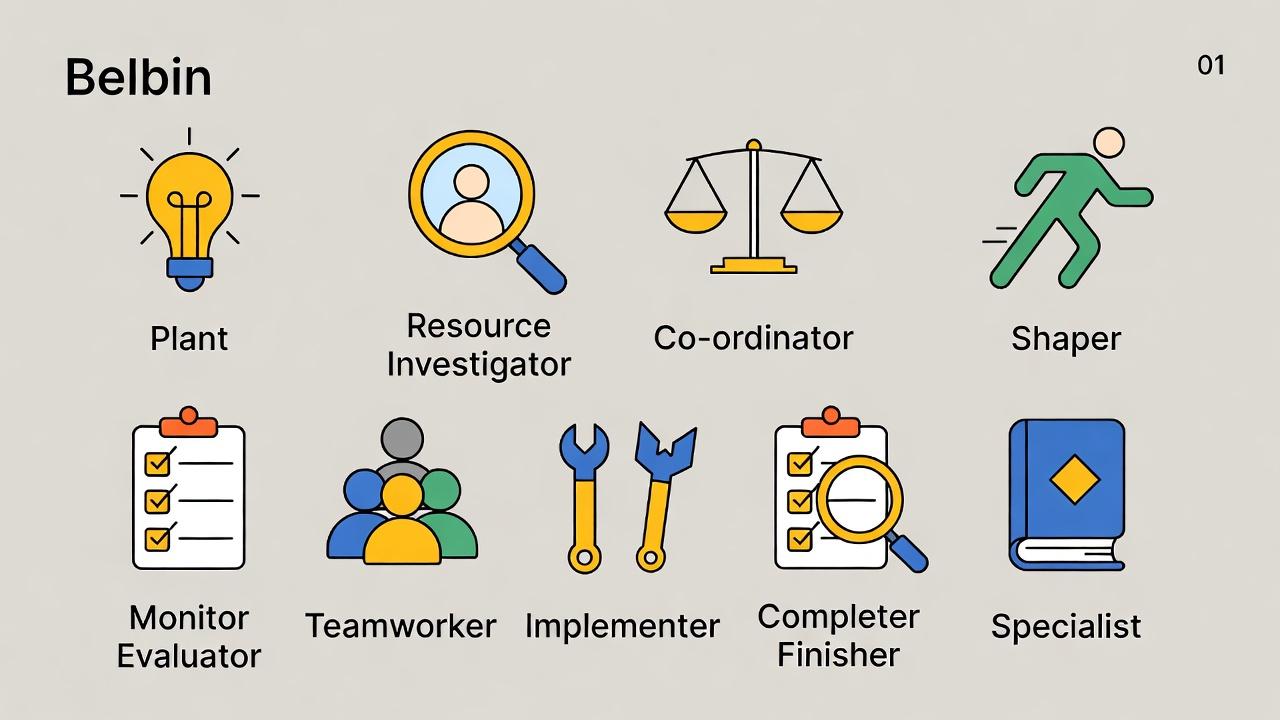
Meredith Belbin spent nine years studying management teams at Henley Business School before publishing his findings in 1981. His research question was straightforward: why do some teams succeed while others, composed of equally talented individuals, fail? The answer, he concluded, had less to do with individual ability and more to do with the balance of roles within the team. A team of brilliant strategists with no one willing to implement their ideas will underperform. A team of doers with no one generating creative solutions will execute efficiently but solve the wrong problems.
This insight — that team performance depends on role diversity rather than individual excellence — is the foundation of Belbin's model. He identified nine distinct team roles, each representing a cluster of behavioural tendencies that contribute to team effectiveness. The model doesn't suggest that every team needs nine people; individuals typically have two or three preferred roles and can adopt others when needed. What matters is that the team collectively covers the necessary roles.
The Nine Team Roles
Belbin grouped the nine roles into three categories: thinking roles (concerned with ideas and analysis), action roles (concerned with getting things done), and people roles (concerned with relationships and coordination).
Thinking Roles
Plant — The creative innovator who generates original ideas and solves problems in unconventional ways. Plants are imaginative and often introverted, preferring to work independently before bringing ideas to the group. They're essential for teams facing novel challenges that require fresh thinking.
Plants can be poor communicators, preoccupied with their own ideas to the point of ignoring practical constraints. Belbin described their "allowable weakness" as a tendency to be too absorbed in thought to communicate effectively. They may also ignore details or dismiss ideas from others if they've already formed their own solution. The team needs Plants for innovation, but Plants need the team to refine and implement their ideas.
Monitor Evaluator — The analytical thinker who assesses ideas objectively and makes sound judgements. Monitor Evaluators are strategic, discerning, and rarely wrong in their assessments. Where Plants generate ideas, Monitor Evaluators determine which ideas are viable. They see all options and judge them accurately.
Their allowable weakness is a tendency toward over-criticism and a lack of drive. Monitor Evaluators can be perceived as cold, unenthusiastic, or overly negative because they analyse rather than inspire. They may slow a team down with their caution, but they also prevent the team from pursuing flawed ideas. In environments that value speed and enthusiasm, Monitor Evaluators can feel undervalued despite their essential contribution.
Specialist — The person who provides in-depth knowledge in a specific area. Specialists are dedicated professionals who take pride in their expertise. They contribute a depth of knowledge that other team members lack, and their input is often essential for technically complex aspects of the team's work.
Specialists tend to focus narrowly on their own area of expertise, contributing only when their speciality is relevant and sometimes dwelling on technicalities. Their allowable weakness is a limited contribution to areas outside their specialism. In a team that needs broad thinking, a Specialist can seem disconnected; in a team facing a technical challenge, they're indispensable.
Action Roles
Shaper — The dynamic, challenging individual who drives the team forward under pressure. Shapers are task-focused, competitive, and direct. They push through obstacles, challenge complacency, and ensure the team doesn't lose momentum. In pressured situations, their energy and determination are invaluable.
Shapers can be aggressive, provocative, and insensitive to others' feelings. Their directness, which is useful for cutting through indecision, can bruise egos and create conflict. Teams with multiple Shapers often experience interpersonal friction. But teams without a Shaper risk losing urgency and allowing comfortable mediocrity.
Implementer — The practical organiser who turns ideas and plans into workable procedures. Implementers are reliable, disciplined, and efficient. They take abstract strategies and translate them into concrete action steps. Where Plants dream up solutions and Shapers push for action, Implementers create the structures that make things happen.
Implementers can be inflexible and resistant to change. Their strength lies in creating order and process, which means they may struggle when plans need to change rapidly. Their allowable weakness is a reluctance to abandon familiar approaches even when circumstances demand adaptation. They bring essential discipline to teams that might otherwise remain in a cycle of ideation without execution.
Completer Finisher — The detail-oriented perfectionist who ensures work is completed to a high standard and on time. Completer Finishers are conscientious, anxious about errors, and driven to meet deadlines. They polish output, check for mistakes, and ensure nothing falls through the cracks.
Their allowable weakness is a tendency to worry excessively and a reluctance to delegate. Completer Finishers may spend disproportionate time on minor details when the team needs to move on. They can also create tension by imposing their standards on others who may not share their concern for perfection. But in environments where quality and accuracy matter — and in most professional contexts, they do — Completer Finishers are essential.
People Roles
Coordinator — The mature, confident individual who clarifies goals, promotes decision-making, and delegates effectively. Coordinators draw out contributions from all team members, summarise discussions, and keep the team focused on objectives. They lead through facilitation rather than dominance.
Coordinators can be perceived as manipulative, delegating their own work to others while taking credit for the team's output. Their skill at orchestrating others can look like laziness if misunderstood. Their allowable weakness is a tendency to offload personal tasks. However, their ability to harness the team's collective strengths and ensure everyone contributes is a genuine and important leadership function.
Teamworker — The diplomatic, perceptive individual who listens, builds relationships, and reduces friction within the team. Teamworkers are sensitive to others' emotions and skilled at mediating conflict. They create the social cohesion that allows teams to function effectively, especially during periods of stress or disagreement.
Their allowable weakness is indecisiveness and a tendency to avoid confrontation. Teamworkers may prioritise harmony over truth, avoiding difficult conversations that the team needs to have. In teams that value directness, Teamworkers can seem too accommodating. But without their social sensitivity, teams fracture under pressure.
Resource Investigator — The enthusiastic, outgoing individual who explores opportunities and develops external contacts. Resource Investigators are networkers — they find people, resources, and ideas outside the team and bring them in. They're energised by new possibilities and are often the team's link to the wider organisation or external environment.
Their allowable weakness is a tendency to lose enthusiasm once the initial excitement fades. Resource Investigators are excellent at starting things but may not follow through. They can over-promise based on their optimism. But their ability to connect the team with external resources and opportunities is vital for teams that might otherwise become insular.
How the Roles Work Together
The value of Belbin's model isn't in the individual role descriptions — it's in understanding how roles interact within a team. Effective teams need a balance of roles. Too many of one type creates dysfunction:
Too many Plants and the team generates endless ideas but never implements any of them. Creative energy without practical application leads to frustration and inaction.
Too many Shapers and the team becomes a battleground of competing wills. Everyone wants to drive the agenda, and interpersonal conflict replaces productive work.
Too many Implementers and the team executes efficiently but lacks innovation. Problems are solved using established methods even when the situation demands a fresh approach.
No Completer Finisher and quality suffers. Work goes out with errors, deadlines slip, and details are overlooked.
No Teamworker and relationships deteriorate under pressure. Conflicts go unresolved, quieter team members withdraw, and the team fragments into individuals working in parallel rather than together.
Belbin's research found that the most effective teams weren't composed of the most individually talented people — they were the ones with the most balanced role composition. This finding challenges the assumption that team performance is simply the sum of individual capabilities.
Allowable Weaknesses
A distinctive feature of Belbin's model is the concept of allowable weaknesses. Every role has a flip side — the same tendencies that create a role's strength also produce its weakness. The Plant's creativity comes with impracticality. The Shaper's drive comes with insensitivity. The Teamworker's diplomacy comes with indecisiveness.
Belbin argued that these weaknesses are the price of the associated strengths and should be tolerated rather than eliminated. Trying to make a Plant more practical risks suppressing their creativity. Trying to make a Shaper more sensitive risks diminishing their drive. The goal isn't to eliminate weaknesses but to ensure the team compensates for them collectively.
This has practical implications for people professionals. Performance management conversations that focus entirely on "areas for improvement" may inadvertently try to eliminate behaviours that are inseparable from an individual's primary contribution. A more nuanced approach recognises that developing people means building on their natural strengths while ensuring team composition compensates for associated weaknesses.
Applying Belbin in HR Practice
Recruitment and Team Composition
When building or restructuring teams, Belbin's model provides a framework for identifying what roles are missing. If an existing team is strong on ideas (Plants, Monitor Evaluators) but weak on implementation (Implementers, Completer Finishers), recruitment can target candidates whose natural roles fill the gap. This doesn't mean using Belbin as the sole selection criterion, but it adds a dimension beyond technical competence.
Team Development
Belbin is widely used in team development programmes. When team members understand each other's preferred roles, they develop appreciation for different contributions. The person who always raises concerns (Monitor Evaluator) is no longer seen as negative but as performing a vital quality-assurance function. The person who keeps checking details (Completer Finisher) isn't being difficult; they're ensuring the team's output meets standards.
Conflict Resolution
Many team conflicts become intelligible through the Belbin lens. Two Shapers competing for dominance. A Plant frustrated by an Implementer's insistence on practicality. A Coordinator perceived as lazy by an Implementer who wants everyone to share the workload equally. Understanding that these frictions arise from role differences rather than personal animosity helps teams work through conflict constructively.
Individual Development
Knowing your own preferred Belbin roles helps you understand your contribution and manage your own weaknesses. It also helps you identify roles you might develop — someone with Specialist and Monitor Evaluator tendencies might work on developing their Resource Investigator skills to become more externally connected.
Criticisms and Limitations
Belbin's model, despite its widespread use, has attracted legitimate criticism that CIPD students should acknowledge.
Psychometric concerns. Research on the reliability and validity of the Belbin Self-Perception Inventory (the questionnaire used to identify preferred roles) has produced mixed results. Some studies have found that the inventory doesn't consistently measure the nine distinct roles the model proposes. This doesn't invalidate the model's practical insights, but it does question the precision of the measurement tool.
Oversimplification. Categorising complex team behaviour into nine roles inevitably simplifies reality. People don't fit neatly into categories, and their behaviour in teams is influenced by many factors beyond role preference — power dynamics, organisational culture, task demands, personal relationships, and external pressures all shape how people contribute.
Context dependency. The model says less about how different contexts affect which roles are most valuable. A team in crisis mode needs different role balance than a team in a stable, routine environment. A creative agency needs different balance than a compliance department. The model provides the framework but not the contextual guidance for application.
Limited developmental perspective. Belbin describes team composition at a point in time but says less about how teams develop and change over time. Tuckman's model of team development (forming, storming, norming, performing) addresses this temporal dimension more effectively. Combining Belbin with Tuckman provides a more complete picture — Belbin for composition, Tuckman for development.
Cultural assumptions. The research was primarily conducted with British management teams. Team dynamics and the value placed on different contributions may vary across cultures. Roles that are valued in individualistic cultures might be less relevant in collectivist contexts.
Using Belbin in CIPD Assignments
When writing about team dynamics in CIPD assignments, Belbin provides a useful analytical framework. Several approaches strengthen your work:
Apply to a real team. Rather than listing the nine roles abstractly, analyse an actual team you've worked in or observed. Which roles were present? Which were missing? How did the balance (or imbalance) affect performance? This demonstrates application, which assessors value more than description.
Compare with other models. Belbin explains team composition; Tuckman explains team development; the psychological contract explains individual expectations. Using multiple frameworks shows analytical sophistication. For example, a team in Tuckman's storming phase might be experiencing Shaper-on-Shaper conflict, which Belbin helps explain.
Discuss practical implications. What would you recommend based on your Belbin analysis? Would you restructure the team? Recruit for a missing role? Use development interventions? Connecting analysis to actionable recommendations demonstrates the practical orientation CIPD assessors look for.
Acknowledge the limitations. Don't present Belbin as a perfect model. Note the psychometric concerns, the oversimplification risk, and the contextual limitations. This critical engagement distinguishes Level 5 analysis from Level 3 description.
Connect to organisational outcomes. Why does team composition matter for the organisation? Link Belbin's insights to performance, engagement, innovation, or whatever outcomes your assignment addresses. This connection between team-level dynamics and organisational-level outcomes demonstrates strategic thinking.