The CIPD CPD Cycle Explained: All Stages Including Reflect and Record
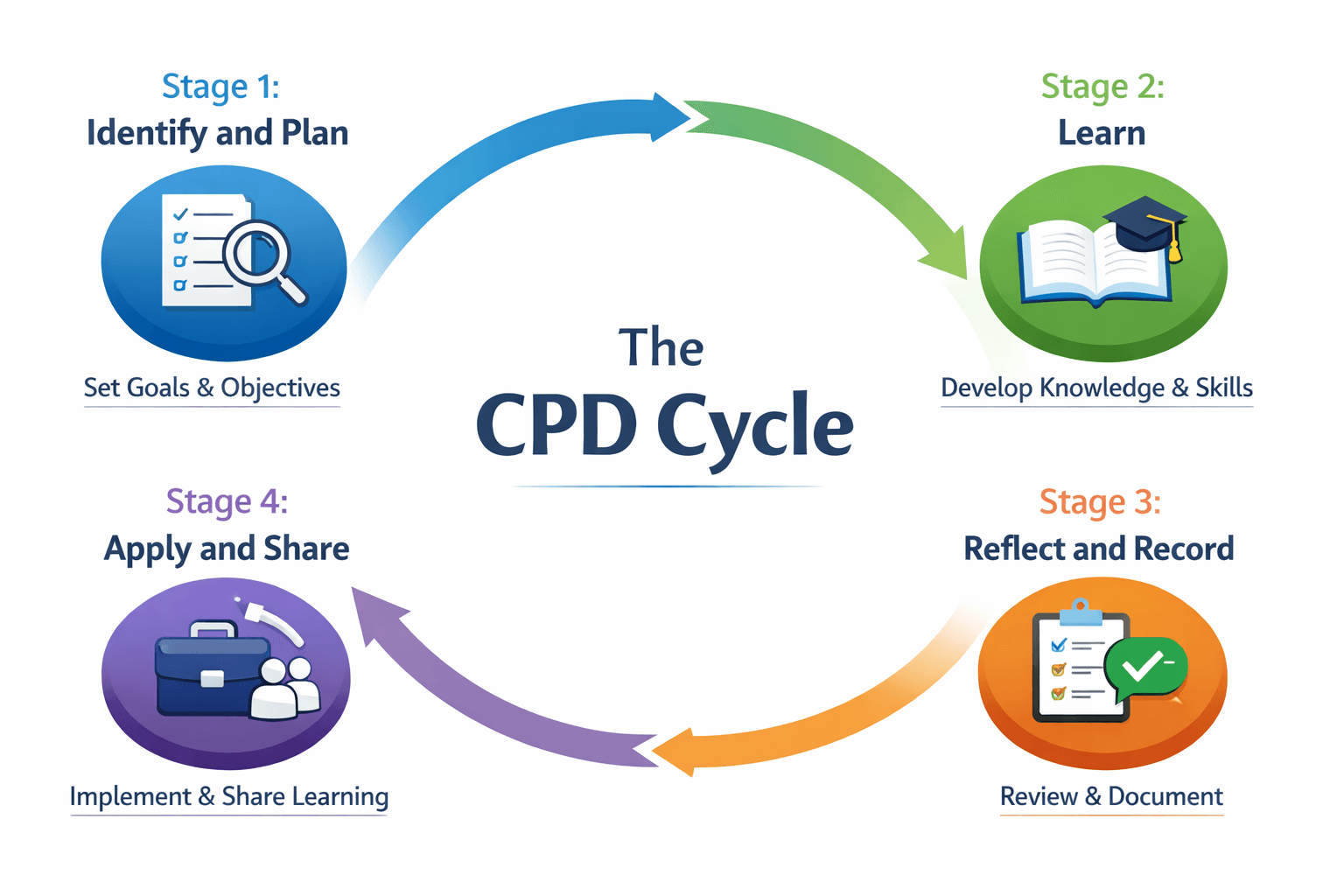
Continuing Professional Development is one of those concepts that every CIPD student encounters but many treat as a tick-box exercise. Fill in a form, log some hours, move on. That approach misses the point entirely. The CIPD designed its CPD cycle as a genuine framework for professional growth — a structured way to identify what you need to learn, engage with meaningful development, reflect on what you've gained, and apply it in practice. Understanding this cycle properly matters both for your assignments and for your career.
Quick answer
The CIPD CPD cycle is a continuous process of identifying development needs, planning learning, learning, reflecting and recording what was gained, then applying and sharing it. The cycle links professional development to practice rather than treating CPD as a one-off course or a simple record of hours.
The four stages
Identify and Plan: Recognise development needs and set a realistic plan.
Learn: Engage with formal or informal learning that addresses those needs.
Reflect and Record: Consider what was learned and document its value.
Apply and Share: Use learning in practice and share useful insight with others.
The CPD cycle isn't a rigid process with a fixed start and end point. It's continuous and iterative. You move through the stages repeatedly throughout your career, sometimes spending longer on one stage than another, sometimes circling back when new needs emerge. The cycle works because it connects learning to practice — it prevents development from becoming something that happens in a classroom but never reaches the workplace.
Why the CIPD Takes CPD Seriously
The CIPD recommends that members spend around 30 hours each year on planned learning, alongside the unplanned learning that happens naturally through work. But the emphasis isn't really on counting hours. What matters is the impact of your learning and how it changes your professional practice.
This distinction is important. You could attend a three-day conference and learn nothing meaningful, or you could have a fifteen-minute conversation with a colleague that fundamentally changes how you approach a problem. The CPD cycle is designed to capture both — it recognises that development comes from formal courses and qualifications, but also from everyday experiences, conversations, mistakes, and observations.
The CIPD Profession Map sets out the knowledge and behaviours expected of people professionals at different levels. Your CPD should be guided by where you stand against these standards and where you want to get to. This isn't abstract — it's about identifying specific gaps in your practice and addressing them deliberately.
Stage 1: Identify and Plan
The first stage asks two fundamental questions: where am I now, and where do I want to get to?
This sounds simple, but honest self-assessment is harder than it appears. Most people overestimate their capabilities in areas they're comfortable with and avoid thinking about areas where they're weaker. The CIPD's self-assessment tool on the Learning Hub helps by measuring your practice against the Profession Map standards, giving you a structured view of your strengths and development needs.
Effective identification goes beyond the self-assessment tool. Consider feedback you've received from managers, colleagues, or stakeholders. Think about situations where you've felt uncertain or out of your depth. Reflect on where your profession is heading and what skills you'll need in the future. If your organisation is adopting new technology, restructuring, or facing new regulatory requirements, those changes create development needs you should anticipate.
Once you've identified your needs, the planning stage involves deciding how to address them. A good development plan is specific and realistic. Rather than writing "improve my knowledge of employment law," a useful plan might say "complete the CIPD employment law factsheet series and attend the ACAS webinar on dismissal procedures by the end of March." Clear actions and dates create accountability.
Planning should also recognise that not all learning needs a formal course. Mentoring relationships, job shadowing, reading, involvement in cross-functional projects, and volunteering for new responsibilities are all legitimate development activities. The best plans combine different approaches because people learn in different ways and some skills are better developed through practice than through study.
Stage 2: Learn
This stage is where you actually engage in learning experiences. These might be planned activities from your development plan, or they might be unplanned experiences that arise in the course of your work.
Planned learning is what most people think of when they hear "CPD" — attending workshops, completing courses, reading professional literature, participating in webinars, engaging with mentoring programmes, or taking on stretch assignments. These are activities you've deliberately chosen to address identified development needs.
But unplanned learning is equally valuable, and the CIPD explicitly recognises this. Consider how much you learn from situations you didn't anticipate: handling a difficult employee relations case for the first time, navigating a restructure, adapting to a new HRIS system, or working with a team whose approach challenges your assumptions. These experiences often teach more than any formal course because they demand immediate application and carry real consequences.
The key at this stage is awareness. Unplanned learning only counts as development if you recognise it as such. Many professionals learn constantly through their work but never acknowledge it because it doesn't look like traditional training. Developing the habit of noticing when you're learning — when something surprises you, when you adapt your approach, when you solve a problem you haven't faced before — is itself a professional skill.
The CIPD provides extensive resources for planned learning through its Knowledge Hub, including factsheets, guides, podcasts, research reports, and case studies. Members can also access free learning courses on the Learning Hub and engage with the online community and mentoring platform. Training providers, professional networks, and branch events offer further opportunities.
Stage 3: Reflect and Record
This is the stage that generates the most search queries from CIPD students — and the one most people find difficult. Reflection requires you to step back from an experience and think critically about what you learned, why it matters, and how it changes your future practice.
Reflection is not the same as description. Saying "I attended a workshop on performance management" is description. Saying "the workshop challenged my assumption that annual appraisals are sufficient — I now understand that regular, informal feedback conversations are more effective at driving behaviour change, and I plan to restructure our team's approach accordingly" is reflection. The difference is analysis and application.
The CIPD's My CPD Records tool on the Learning Hub provides a structured space for reflection. It guides you through four key questions:
What is the learning experience you're reflecting on? This is the descriptive element — what happened, what you engaged with, and what the context was.
What did you learn from this experience? This moves beyond description into analysis. What new knowledge, insight, or perspective did you gain? What surprised you? What confirmed or challenged your existing understanding?
How does this change the way you'll work in the future? This is the most important question. Reflection without application is merely interesting. The purpose of reflecting on learning is to identify concrete changes to your practice. What will you do differently? What will you start, stop, or continue?
What else have you done — or what will you do — for this learning experience to have a wider positive impact? This connects reflection to the broader context. Have you shared your learning with colleagues? Could your insight benefit your team or organisation? This question anticipates Stage 4 and encourages you to think beyond personal development.
Why Students Find Stage 3 Difficult
Many CIPD students struggle with reflection because formal education rarely teaches it explicitly. You're taught to analyse external information — case studies, data, theories — but reflecting on your own experience requires a different kind of thinking. It demands honesty about what you don't know, willingness to admit when your assumptions were wrong, and the discipline to connect abstract learning to concrete practice.
There's also a natural tendency to write reflections that are too positive. Genuine reflection includes acknowledging what didn't go well, where you were uncertain, and what you'd do differently. Assessors and the CIPD value honest, critical reflection far more than polished narratives where everything went perfectly.
If you find reflection difficult, consider using a reflective model to give your thinking structure. The Gibbs reflective cycle, Kolb's experiential learning cycle, and Schön's reflection-in-action and reflection-on-action all provide frameworks that can help you move beyond description into genuine analysis. These models aren't required by the CPD cycle, but they can be useful scaffolding while you develop your reflective practice.
Recording Your CPD
The recording element of Stage 3 serves multiple purposes. It creates a permanent record of your development journey that you can review over time. It forces you to articulate your reflections clearly — writing things down requires more precision than thinking them through informally. And it provides evidence of your professional development that the CIPD may request as part of its membership requirements.
Good CPD records are concise but substantive. They capture the essence of what you learned and how it changes your practice without becoming lengthy essays. Aim for clarity and specificity — "I will implement monthly one-to-one feedback sessions with my team starting in April" is more useful than "I will improve my approach to performance management."
Stage 4: Apply and Share
The final stage completes the connection between learning and practice. Application means finding opportunities to use what you've learned — starting new projects, taking on challenges outside your comfort zone, experimenting with different approaches, and seeking feedback on how your changed practice is working.
Application isn't always immediate. Some learning takes time to find the right opportunity for implementation. A new approach to conflict resolution might wait until the next employee relations issue arises. Knowledge of a new legislative change might not become relevant until the next policy review. The important thing is to actively look for opportunities rather than letting learning sit unused.
Sharing is the social dimension of CPD. When you share what you've learned with colleagues, teams, or wider professional networks, several things happen. You reinforce your own understanding — explaining something to others requires you to organise your thinking and fill gaps in your knowledge. You contribute to a culture of learning within your organisation. And you build your professional reputation and network.
Sharing can take many forms. Presenting at team meetings, writing internal briefing papers, contributing to online communities, blogging about professional insights, mentoring less experienced colleagues, or participating in professional networks and CIPD branch events all count. The CIPD Communities platform provides a space for sharing and discussion with other people professionals.
Sharing also creates feedback loops that feed back into Stage 1. When you share an idea, others respond — they challenge your thinking, offer alternative perspectives, or build on your insights. This dialogue often reveals new development needs or deepens your understanding of existing ones, starting the cycle again.
The Cycle Is Continuous
It's worth emphasising that the CPD cycle doesn't have a definitive end point. Applying and sharing your learning typically reveals new gaps, sparks new questions, or opens up new areas of interest. These feed back into the identification stage, and the cycle continues.
Over time, this creates compound growth in your professional capability. Each cycle builds on previous ones. Your ability to identify development needs becomes more sophisticated as you gain experience. Your learning becomes more targeted and efficient. Your reflective practice deepens. Your application becomes more confident. This is why the CIPD frames CPD as continuing — it's a career-long habit, not a qualification requirement you complete and forget.
Using the CPD Cycle in Your CIPD Assignments
The CPD cycle appears in several CIPD units, most prominently in 5CO03 (Professional Behaviours and Valuing People) and various Level 3 units. When writing about CPD in assignments, several approaches strengthen your work.
First, demonstrate that you understand the cycle as a connected process, not a list of separate stages. Assessors want to see that you recognise how identification leads to planning, how learning feeds into reflection, and how application circles back to identification. Treating the stages as isolated steps misses the fundamental point.
Second, use personal examples wherever possible. If the assignment asks you to discuss your approach to CPD, draw on real development experiences. Describe a specific learning need you identified, what you did about it, how you reflected on it, and how it changed your practice. Concrete examples are always stronger than abstract descriptions of what you would theoretically do.
Third, be critical. Acknowledge the limitations and challenges of CPD. Not all development is equally valuable. Time constraints are real. Organisational support for CPD varies. Reflection is difficult. Honest engagement with these challenges demonstrates maturity and critical thinking — qualities assessors look for at Level 5 and above.
Fourth, connect CPD to the broader context of professional practice. CPD exists because the people profession evolves constantly — employment law changes, technology transforms HR processes, organisational expectations shift, and new research challenges established practices. Show that you understand CPD as a response to this reality, not just a CIPD membership requirement.
Finally, reference the CIPD Profession Map when discussing CPD. The map provides the framework against which your development should be measured. Showing that you understand how CPD connects to the knowledge and behaviours the profession expects demonstrates alignment with CIPD standards.
Common Mistakes When Writing About CPD
Confusing the CPD cycle with reflective models. The CPD cycle is a framework for structuring your overall professional development. Gibbs reflective cycle, Kolb's learning cycle, and similar models are tools for reflecting on specific experiences. You might use Gibbs within Stage 3 of the CPD cycle, but they're not the same thing and shouldn't be conflated.
Treating CPD as purely formal learning. If your CPD portfolio only includes courses and workshops, you're missing half the picture. The CIPD explicitly values unplanned, informal, and workplace-based learning. Include examples of learning through experience, not just learning through instruction.
Describing activities without reflecting on impact. Listing what you did isn't CPD. The value comes from analysing what you learned, how it changed your practice, and what impact it had. A shorter portfolio with genuine reflection is worth more than a longer one with only descriptions.
Ignoring the planning stage. Responsive CPD — learning whatever happens to come along — is better than no CPD, but it's not strategic. The strongest CPD combines responsiveness to unplanned opportunities with deliberate planning based on identified needs. Show that your development is purposeful, not random.
Writing only positive reflections. Development involves struggle, uncertainty, and occasionally getting things wrong. Reflections that only describe successful outcomes lack credibility. Including honest accounts of challenges, mistakes, and ongoing development needs demonstrates the kind of self-awareness the profession values.