Gibbs' Reflective Cycle: A Complete Guide for CIPD Students
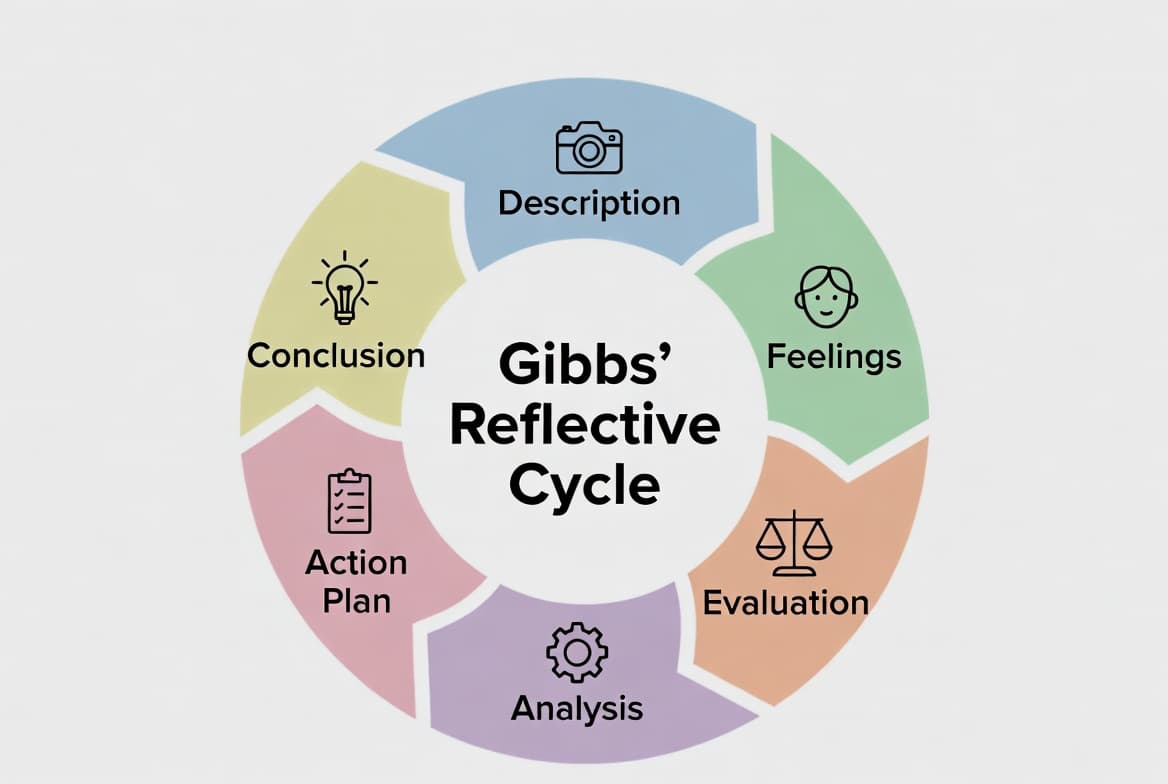
Graham Gibbs developed his Reflective Cycle in 1988 as part of his work on learning by doing. The model has become one of the most widely used frameworks for structured reflection in professional education—including CIPD qualifications where reflective practice is a core requirement.
Whether you're working on 5CO03 (Professional Behaviours and Valuing People), 3CO03 (Core Behaviours for People Professionals), or simply developing your CPD practice, understanding Gibbs will help you reflect more effectively on your experiences and translate them into professional growth.
Why Reflection Matters for People Professionals
CIPD emphasises reflective practice because it's how professionals learn and improve. Reflection helps you:
Learn from experience: — Not just what happened, but what it means
Develop self-awareness: — Understanding your strengths and development areas
Improve practice: — Translating insights into better future performance
Demonstrate professionalism: — Showing commitment to continuous development
The CIPD Profession Map includes "professional courage and influence" and "valuing people" as core behaviours—both require the self-awareness that reflection develops.
The Six Stages of Gibbs' Reflective Cycle
Gibbs' model moves through six stages in a cycle, meaning reflection leads to action, which creates new experiences to reflect on.
Stage 1: Description
What happened?
Start by describing the experience factually and objectively. This isn't analysis yet—just setting the scene.
Questions to consider:
- What was the situation or context?
- Who was involved?
- What did you do?
- What did others do?
- What was the outcome?
Tips:
- Be specific, not vague
- Stick to facts, not interpretations
- Include relevant context
- Keep it concise—save detail for later stages
Example: "In a team meeting, I presented the new absence management policy. Three managers asked challenging questions about implementation. I answered two clearly but struggled with the third about flexible working interactions. The meeting overran by 15 minutes."
Stage 2: Feelings
What were you thinking and feeling?
Explore your emotional and cognitive responses. This stage is often skipped or rushed, but it's important—emotions affect how we process experiences and what we learn from them.
Questions to consider:
- How did you feel before, during, and after?
- What were you thinking at key moments?
- How do you think others felt?
- What feelings stayed with you afterwards?
Tips:
- Be honest about emotions, including uncomfortable ones
- Notice how feelings changed through the experience
- Consider how emotions affected your behaviour
- Recognise that feelings aren't right or wrong—they're data
Example: "I felt confident at the start—I'd prepared thoroughly. When the challenging questions came, I felt my confidence drop. With the third question, I felt embarrassed that I didn't have a good answer. Afterwards, I felt frustrated with myself for not anticipating that question."
Stage 3: Evaluation
What was good and bad about the experience?
Make judgements about the experience. What worked well? What didn't? This is where you start to move beyond description toward assessment.
Questions to consider:
- What went well?
- What didn't go well?
- What did you contribute positively?
- What did others contribute?
- What could have been better?
Tips:
- Be balanced—identify positives and negatives
- Be specific about what worked and what didn't
- Consider different perspectives
- Avoid being overly self-critical or self-congratulatory
Example: "Good: I presented the policy clearly, handled two difficult questions well, and maintained composure even when struggling. Bad: I hadn't fully considered the interaction with flexible working policies, the meeting overran which frustrated attendees, and I didn't follow up on the unanswered question promptly."
Stage 4: Analysis
What sense can you make of the situation?
This is the deepest stage—where you move beyond what happened to why it happened and what it means. Draw on theory, research, and broader understanding to make sense of the experience.
Questions to consider:
- Why did things go well or badly?
- What patterns do you notice in your practice?
- How does this connect to theory or research?
- What does this experience reveal about you?
- What factors influenced the outcome?
Tips:
- Look for root causes, not just symptoms
- Connect to professional knowledge and theory
- Identify patterns across multiple experiences
- Consider systemic factors, not just individual performance
- This is where CIPD content knowledge adds depth
Example: "My confidence dropped because I'd prepared for the policy content but not the cross-policy implications. This reflects a pattern—I focus on my specific task without fully considering stakeholder perspectives. Research on policy implementation emphasises stakeholder analysis and scenario planning. The manager's question was legitimate; my discomfort came from being unprepared, not from the question being unfair."
Stage 5: Conclusion
What else could you have done?
Based on your analysis, consider what alternatives existed. What could you have done differently? What would you do if the same situation arose again?
Questions to consider:
- What could you have done differently?
- What alternatives were available?
- What skills or knowledge would have helped?
- What would you advise someone else in the same situation?
- What have you learned?
Tips:
- Be practical and realistic
- Identify specific alternatives, not just "do better"
- Consider what you need to develop
- Think about both immediate responses and longer-term preparation
Example: "I could have: (1) done a stakeholder impact analysis before the meeting to anticipate questions, (2) mapped our policy against related policies to identify interactions, (3) spoken with managers informally beforehand to understand their concerns, (4) prepared a 'parking lot' approach for questions I couldn't immediately answer."
Stage 6: Action Plan
If it arose again, what would you do?
The final stage translates reflection into concrete action. What will you do differently next time? What development do you need? How will you apply your learning?
Questions to consider:
- What specific actions will you take?
- What will you do differently next time?
- What development activities do you need?
- How will you know if you've improved?
- When will you review progress?
Tips:
- Be specific and actionable
- Set realistic timelines
- Include development activities, not just behaviour changes
- Plan how you'll measure improvement
- Connect to your broader CPD plan
Example: "Actions: (1) For future policy presentations, I will complete a stakeholder impact analysis at least one week before, (2) I will review our policy library to map key interactions between policies, (3) I will book a coaching session to develop my approach to handling unexpected questions, (4) Before my next major presentation, I will do a 'pre-mortem' to anticipate challenges."
Applying Gibbs in CIPD Assignments
5CO03 and 3CO03: Reflective Practice Requirements
These units explicitly require reflection on your professional practice. Use Gibbs to:
- Structure your reflective accounts
- Demonstrate depth of self-awareness
- Connect experiences to professional development
- Show how reflection leads to improved practice
CPD Planning
CIPD requires ongoing CPD, and reflection is how you identify development needs. Use Gibbs to:
- Review significant professional experiences
- Identify patterns in your strengths and development areas
- Generate meaningful CPD activities
- Evaluate the impact of previous development
Assessment Criteria Tips
When assessed on reflective practice:
Don't just describe: — Analysis and Action are where marks are earned
Be honest: — Superficial reflection is obvious; genuine insight is valued
Connect to theory: — Link experiences to professional knowledge
Show development: — Demonstrate how reflection changes practice
Be specific: — Vague reflection suggests limited engagement
Gibbs vs Other Reflective Models
Gibbs vs Kolb
Gibbs vs Schön
When to Use Each
Gibbs: — When you need structured, thorough reflection on specific experiences
Kolb: — When discussing how learning happens or designing learning experiences
Schön: — When discussing the nature of professional expertise and thinking
Criticisms of Gibbs' Reflective Cycle
For critical analysis in assignments:
Too Structured
The six stages can feel mechanical. Real reflection is often messier and more iterative. Some argue the structure constrains rather than enables deep reflection.
Overemphasis on Feelings
While acknowledging emotions is valuable, some contexts require more analytical approaches. Not every professional situation needs emotional exploration.
Individual Focus
The model focuses on individual reflection and may underplay systemic or contextual factors. Organisational issues might be reframed as individual development needs.
Assumed Linearity
The cycle suggests a sequence, but reflection often moves back and forth between stages. Insights at the Analysis stage might require revisiting Description.
Cultural Assumptions
The emphasis on feelings and personal disclosure reflects Western assumptions about reflection. Different cultural contexts may approach reflection differently.
Strengthening Your Gibbs Reflections
Go Deeper in Analysis
The Analysis stage is where most reflections fall short. Push beyond "I should have prepared better" to understand WHY you didn't prepare, WHAT patterns this reveals, and HOW it connects to your professional development.
Use Professional Knowledge
Connect experiences to:
- CIPD Profession Map behaviours
- HR/L&D theory and research
- Organisational context and strategy
- Professional ethics and values
Be Genuinely Self-Critical
Honest reflection acknowledges genuine weaknesses, not just minor areas for improvement. The discomfort of honest reflection is where growth happens.
Track Patterns Over Time
Individual reflections are useful; patterns across reflections are more useful. Keep a reflective log and periodically review for themes.
Close the Loop
Reflection without action is incomplete. Follow through on action plans and reflect again on how the changes worked.
Summary
Gibbs' Reflective Cycle provides a structured approach to learning from experience:
- Description — What happened?
- Feelings — What were you thinking and feeling?
- Evaluation — What was good and bad?
- Analysis — What sense can you make of it?
- Conclusion — What else could you have done?
- Action Plan — What will you do next time?
For CIPD students, Gibbs is particularly useful for reflective accounts in 5CO03 and 3CO03, CPD planning, and developing the self-awareness that underpins professional practice. Use it alongside other models for richer analysis, and remember that the value is in genuine insight, not mechanical completion of stages.