Hackman and Oldham's Job Characteristics Model Explained
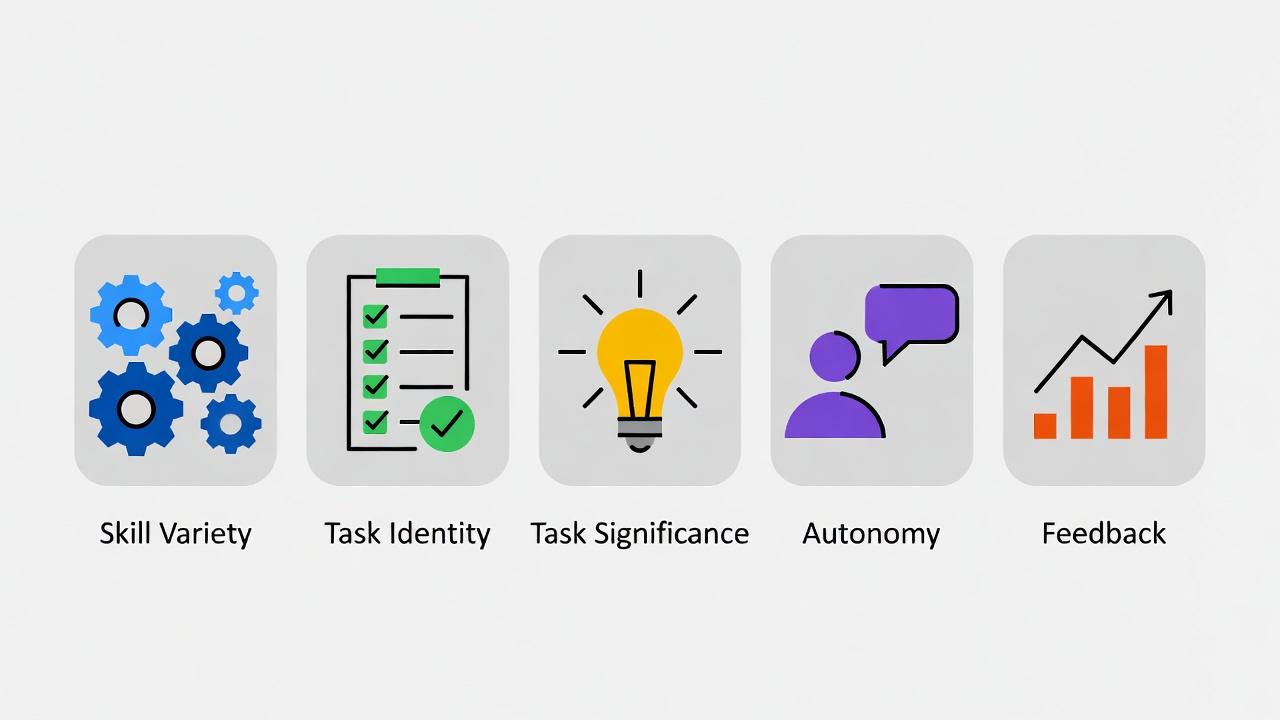
Why do some jobs feel meaningful and engaging while others feel monotonous and draining? This question drives much of what HR professionals do when designing roles, restructuring teams, or trying to improve employee engagement. Hackman and Oldham's Job Characteristics Model, developed in 1976, provides the most widely used answer. It identifies five specific features of jobs that determine how motivating they are, and it explains the psychological mechanisms through which those features affect people.
The model matters for HR practice because it shifts the conversation from "how do we motivate people?" to "how do we design jobs that are inherently motivating?" Rather than relying on external incentives to compensate for poorly designed work, the model suggests that well-designed jobs create intrinsic motivation — people want to do the work because the work itself is satisfying.
The Five Core Job Characteristics
Skill Variety
Skill variety refers to the extent to which a job requires a range of different skills and abilities. A job with high skill variety challenges the worker to use multiple competencies, which creates engagement and reduces monotony. A job with low skill variety involves repetitive use of the same narrow skill set.
Consider the difference between an HR business partner who advises on employee relations, designs development programmes, analyses workforce data, and contributes to strategic planning, versus a data entry clerk who inputs the same type of information into the same system all day. The first role demands varied skills; the second demands one. The first is inherently more stimulating because it engages different capabilities.
This doesn't mean every job needs to be complex. But understanding skill variety helps HR professionals identify roles that may be under-stimulating and consider ways to broaden them — through job rotation, project involvement, or role redesign.
Task Identity
Task identity describes whether a job involves completing a whole, identifiable piece of work from beginning to end, or just contributing a fragment to a larger process. High task identity means the worker can see the complete output of their effort. Low task identity means they contribute to something but never see the finished result.
A recruitment consultant who manages the entire hiring process — from defining requirements through advertising, screening, interviewing, and making the offer — has high task identity. They can point to a successful hire and say "I did that." A screening specialist who reviews CVs and passes shortlists to someone else, never knowing who was eventually hired or how they performed, has low task identity.
When people can see the whole output of their work, they feel greater ownership and take more pride in quality. When they only contribute a fragment, it's harder to feel invested in the outcome.
Task Significance
Task significance refers to the impact the job has on other people — whether colleagues, customers, or society more broadly. Jobs with high task significance affect others in meaningful ways. Jobs with low task significance feel disconnected from any larger purpose.
Most HR roles have inherently high task significance, even when practitioners don't always recognise it. Handling a grievance properly protects someone's wellbeing and career. Designing an effective onboarding programme shapes how new employees experience the organisation for years. Getting redundancy consultations right affects people's livelihoods. When HR professionals understand the significance of what they do, their motivation increases.
The challenge is that task significance isn't always visible. A payroll administrator might view their work as routine data processing, but late or incorrect pay has profound effects on employees and their families. Making significance visible — connecting daily tasks to their human impact — is a powerful motivational lever that costs nothing to implement.
Autonomy
Autonomy refers to the degree of freedom, independence, and discretion the worker has in scheduling their work and determining how it's carried out. High autonomy means the person decides how to approach their tasks. Low autonomy means someone else prescribes the method, timing, and process.
Hackman and Oldham found that autonomy is one of the most powerful predictors of job satisfaction and motivation. When people have control over how they work, they feel personal responsibility for outcomes. When they're simply following prescribed procedures, they feel like an interchangeable cog — if the process determines everything, anyone could do it.
Autonomy doesn't mean absence of accountability. A self-managing team has high autonomy but also clear goals and performance expectations. The autonomy is in the how, not the what. This distinction matters for HR professionals designing jobs and management structures — the question isn't whether to set expectations but whether to prescribe the method of meeting them.
Feedback
Feedback refers to the degree to which carrying out the work activities provides direct, clear information about performance effectiveness. This is feedback from the job itself, not from a manager. A software developer who runs their code and sees immediately whether it works gets direct feedback. A policy writer who submits documents into an approval process and hears nothing for months gets none.
When jobs provide direct feedback, people can self-regulate their performance. They know when they're doing well and when they need to adjust, without waiting for someone to tell them. This creates a sense of competence and control that contributes to intrinsic motivation.
Many jobs in HR and management provide limited direct feedback. You design a training programme, deliver it, and then wait months to see whether it affected performance metrics. Deliberately building feedback mechanisms into jobs — through immediate data, customer responses, or visible outcomes — enhances the motivating potential of the work.
The Three Psychological States
Hackman and Oldham didn't just identify job characteristics in isolation — they proposed that these characteristics create motivation through three critical psychological states:
Experienced meaningfulness — The person feels that their work matters, that it's worthwhile and significant. This state is created by skill variety (the work is challenging), task identity (the work produces a complete outcome), and task significance (the work affects others).
Experienced responsibility — The person feels personally accountable for outcomes. This state is created by autonomy — when you choose how to approach your work, you own the results in a way that's impossible when someone else made all the decisions.
Knowledge of results — The person understands how well they're performing. This state is created by feedback — direct information from the work itself about whether the effort is producing good outcomes.
The model proposes that all three psychological states must be present for full motivation. A job might be deeply meaningful (high skill variety, task identity, and significance) but if the person has no autonomy and no feedback, they'll feel frustrated rather than motivated. They'll know their work matters but feel unable to influence how it's done or whether it's done well.
The Motivating Potential Score
Hackman and Oldham developed a formula to calculate the overall motivating potential of a job:
MPS = ((Skill Variety + Task Identity + Task Significance) / 3) × Autonomy × Feedback
The formula reveals something important about the model's structure. The first three characteristics are averaged — they're interchangeable to some extent, and weakness in one can be compensated by strength in another. But autonomy and feedback are multiplied, which means if either is zero, the entire motivating potential score is zero regardless of how strong the other characteristics are.
This has significant practical implications. A job can be varied, whole, and meaningful, but if the person has no control over how they do it and gets no feedback on how they're doing, the motivating potential collapses. Autonomy and feedback aren't optional extras — they're essential foundations.
The MPS is useful as a diagnostic tool rather than a precise measurement. It helps identify which characteristics are limiting a job's motivating potential and therefore where redesign efforts should focus.
Moderating Variables
Hackman and Oldham recognised that not everyone responds to enriched jobs in the same way. They identified three moderating variables that influence how strongly the core characteristics affect outcomes:
Knowledge and skill — People need to be capable of performing enriched work. High autonomy in a role the person doesn't understand creates anxiety rather than motivation. This connects to the AMO model's emphasis on ability as a prerequisite for performance.
Growth need strength — Some people have a strong desire for personal growth, learning, and challenge. These individuals respond very positively to enriched jobs. Others prefer routine, predictability, and clearly defined tasks. For them, high skill variety and autonomy may feel overwhelming rather than motivating.
Context satisfaction — When people are dissatisfied with pay, job security, co-workers, or supervision, they're less responsive to the motivating potential of the work itself. This echoes Herzberg's distinction between hygiene factors and motivators — basic needs must be met before enriched job design has its full effect.
These moderators are important because they prevent oversimplistic application of the model. Not every job should be maximally enriched, and not every employee will benefit equally from enrichment. Effective job design considers both the characteristics of the work and the characteristics of the people doing it.
Applying the Model in HR Practice
Job Redesign
The most direct application is systematically assessing existing roles against the five characteristics and redesigning those that score poorly. Common interventions include:
Combining tasks to increase skill variety and task identity. Instead of splitting a process across multiple people, allow one person to handle the complete workflow.
Forming natural work units to increase task identity and task significance. Group tasks so that each person or team handles a coherent, meaningful piece of work rather than random fragments.
Establishing client relationships to increase skill variety, autonomy, and feedback. When workers deal directly with the people who use their output, they get immediate feedback, develop varied interpersonal skills, and feel greater responsibility for quality.
Vertical loading to increase autonomy. Give workers responsibility for decisions that were previously made by supervisors — scheduling, quality control, method selection, problem-solving.
Opening feedback channels to increase feedback. Provide workers with direct access to performance data rather than filtering it through management layers.
Recruitment and Role Design
When creating new roles, the five characteristics provide a checklist for designing work that's inherently motivating. Rather than designing narrow, repetitive roles and hoping to compensate with good management and bonuses, design roles that provide variety, wholeness, significance, autonomy, and feedback from the outset.
Engagement Diagnosis
When engagement survey results are poor, the Job Characteristics Model helps identify why. Low engagement might not reflect poor management or inadequate pay — it might reflect fundamentally under-designed jobs. If a team has no autonomy and no feedback, no amount of motivational speeches will create genuine engagement.
Using the Model in CIPD Assignments
The Job Characteristics Model is relevant across multiple CIPD units, particularly 5HR03 (Reward for Performance and Contribution) and any unit addressing job design, motivation, or engagement.
Connect it to other motivation theories. Show how the JCM relates to Herzberg's motivators, Maslow's self-actualisation, or the AMO model's opportunity component. A job designed according to the JCM principles provides the meaningful work (Herzberg), the growth opportunities (Maslow), and the conditions for contribution (AMO) that multiple theories identify as essential.
Apply it practically. Analyse a real job — your own or one you're familiar with — using the five characteristics. Calculate or estimate the Motivating Potential Score. Identify which characteristics are weakest and propose specific redesign interventions. This applied analysis demonstrates the practical skills assessors value.
Discuss the moderating variables. Don't just describe the model — engage with its complexity. Acknowledge that growth need strength varies between individuals, that context satisfaction matters, and that enriched job design isn't universally appropriate. This nuanced engagement demonstrates critical thinking.
Consider contemporary relevance. How does the model apply to remote work, gig work, or AI-augmented roles? Has technology changed how the five characteristics manifest? These questions demonstrate your ability to apply established theory to current challenges — exactly what CIPD assessors look for at Level 5.