5CO02 Evidence-Based Practice: Complete Study Guide
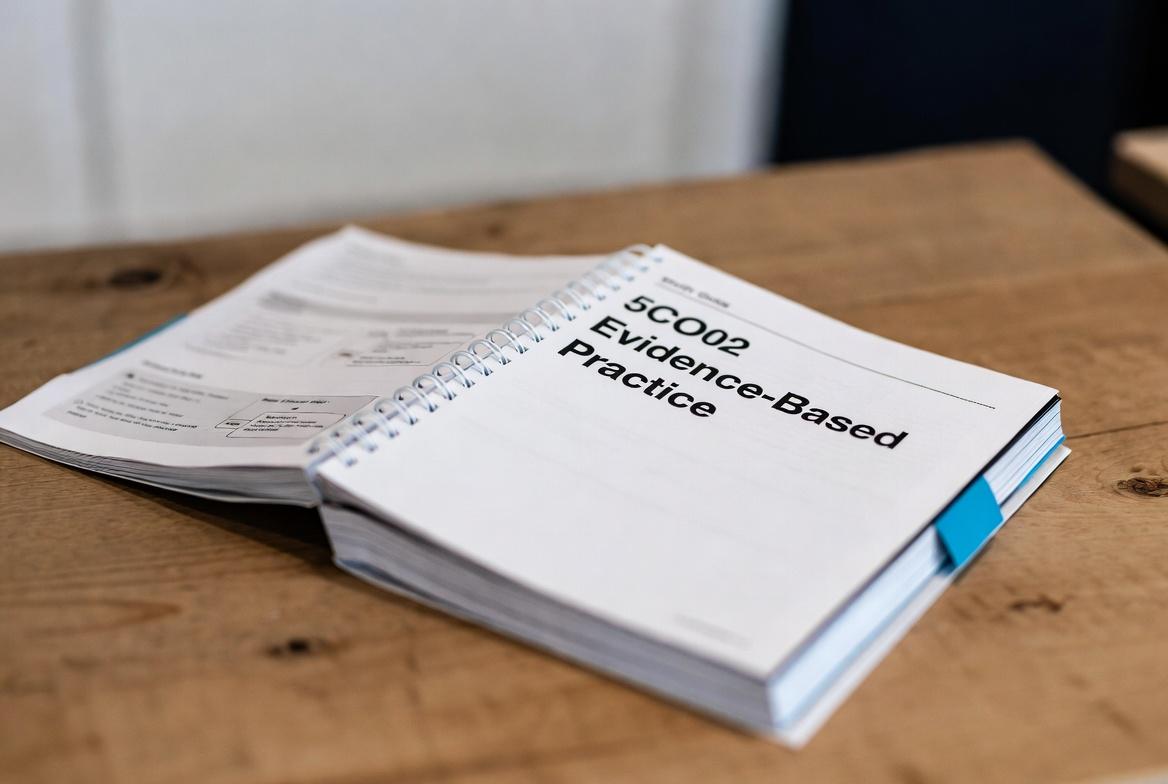
5CO02 Evidence-Based Practice is one of three core units in the CIPD Level 5 Associate Diploma. Worth 6 credits, it focuses on a fundamental professional skill: making decisions based on robust evidence rather than intuition or tradition. This unit will transform how you approach problems and justify your recommendations.
This guide breaks down everything you need to understand about 5CO02, including the key concepts, analysis tools, and what each assessment criterion is asking for.
Free Video Explainers: People Study Pro members get free access to video explanations of McKinsey 7S Framework, Porter's Five Forces, and other analysis tools. Sign up free →
What You'll Learn in 5CO02
The unit covers three main learning outcomes:
- Understand strategies for effective critical thinking and decision-making — Evidence-based practice concepts, analysis tools, critical thinking principles, decision-making processes, and ethical perspectives.
- Understand the importance of decision-making strategies to solve people practice issues — Interpreting data, presenting findings, and making justified recommendations with cost-benefit analysis.
- Be able to measure the impact and value of people practice to the organisation — Financial and non-financial performance measures, and demonstrating HR's contribution.
What Is Evidence-Based Practice?
Evidence-based practice (EBP) originated in medicine and has been adopted across professions including HR. The core principle is simple: decisions should be based on the best available evidence, not just gut feeling, tradition, or what's convenient.
The Four Sources of Evidence
Evidence-based HR draws on four sources:
- Scientific research — Academic studies, meta-analyses, peer-reviewed findings
- Organisational data — Internal metrics, analytics, performance data
- Professional expertise — Practitioner knowledge and experience
- Stakeholder input — Employee feedback, manager perspectives, customer views
Good decisions integrate all four, recognising that each has limitations.
Why It Matters
Research suggests many HR practices are based on tradition or intuition rather than evidence. Common examples:
- Unstructured interviews (poor predictors of performance, but widely used)
- Personality tests for roles where they don't predict success
- Training programmes with no evaluation of impact
- Policies based on "best practice" without checking fit
Evidence-based practice challenges these habits and demands justification.
Key Analysis Tools for 5CO02
Your assignment requires you to evaluate analysis tools. Here are the main ones:
Environmental Analysis
PESTLE Analysis
- Political, Economic, Social, Technological, Legal, Environmental factors
- Used to scan the external environment
- Helps identify threats and opportunities
- Link to your PESTLE explainer
SWOT Analysis
- Strengths, Weaknesses, Opportunities, Threats
- Combines internal (S/W) and external (O/T) analysis
- Simple but can be superficial if not done rigorously
Porter's Five Forces
- Competitive rivalry, supplier power, buyer power, threat of substitution, threat of new entry
- Analyses industry attractiveness and competitive dynamics
- Useful for strategic HR decisions
Organisational Analysis
McKinsey 7S Framework
- Strategy, Structure, Systems, Shared Values, Style, Staff, Skills
- Analyses organisational alignment
- Useful for change and transformation projects
Balanced Scorecard
- Financial, Customer, Internal Process, Learning & Growth perspectives
- Links strategy to measurable objectives
- Useful for HR metrics and dashboards
Problem Analysis
Fishbone (Ishikawa) Diagram
- Also called cause-and-effect diagram
- Maps potential causes of a problem
- Categories often include: People, Process, Policy, Plant/Technology, Environment
- Useful for root cause analysis
Force Field Analysis
- Identifies driving forces (for change) and restraining forces (against)
- Helps plan change interventions
- Links to Lewin's change model
Critical Incident Analysis
- Examines specific events to identify patterns
- Useful for understanding what works and what doesn't
- Often used in learning needs analysis
Decision-Making Tools
De Bono's Six Thinking Hats
- White (facts), Red (emotions), Black (caution), Yellow (optimism), Green (creativity), Blue (process)
- Structures group discussion
- Ensures multiple perspectives are considered
Cost-Benefit Analysis
- Compares costs of a solution against expected benefits
- Includes direct and indirect costs
- Essential for business cases
Critical Thinking Principles
Critical thinking is central to 5CO02. Key principles:
Questioning and Scepticism
- Don't accept claims at face value
- Ask "what's the evidence for this?"
- Consider who benefits from a particular conclusion
- Look for alternative explanations
Evaluating Sources
- Is the source credible and authoritative?
- Is there potential bias?
- Is the evidence current?
- Can findings be replicated or verified?
Distinguishing Fact from Opinion
- Facts can be verified; opinions cannot
- "Research shows..." is different from "I believe..."
- Be precise about what the evidence actually says
Recognising Bias
Confirmation bias: — Seeking evidence that confirms what we already believe
Availability bias: — Overweighting recent or memorable information
Anchoring: — Over-relying on first information received
Groupthink: — Conforming to group consensus without critical evaluation
Triangulation
- Use multiple sources and methods
- If different sources reach the same conclusion, confidence increases
- Single sources should be treated cautiously
Ethical Perspectives in Decision-Making
5CO02 requires you to understand how ethics influence decisions. Key perspectives:
Utilitarianism
- Judges actions by their consequences
- "Greatest good for the greatest number"
- Focuses on outcomes, not intentions
- Challenge: can justify harming minorities for majority benefit
Deontology (Kantian Ethics)
- Judges actions by whether they follow moral rules
- Some things are right or wrong regardless of consequences
- Emphasises duties and rights
- Challenge: rules can conflict; doesn't account for context
Virtue Ethics
- Focuses on character and what a "good person" would do
- Emphasises professional integrity
- Considers long-term reputation and relationships
- Challenge: subjective; different virtues in different contexts
Applying Ethics to HR Decisions
Consider ethical perspectives when:
- Making redundancy decisions (who to select, how to treat people)
- Handling performance issues (compassion vs accountability)
- Implementing surveillance or monitoring
- Balancing business needs with employee welfare
- Dealing with whistleblowing or misconduct
Assessment Criteria Breakdown
Learning Outcome 1: Critical Thinking and Decision-Making
AC 1.1: Evaluate the concept of evidence-based practice including how it can be applied to decision-making in people practice
This asks you to:
- Define evidence-based practice
- Explain its four sources (research, data, expertise, stakeholders)
- Discuss how it applies to HR decision-making
- Consider models of decision-making (rational model, bounded rationality)
- Evaluate strengths and limitations
Key verb: "Evaluate" means assess the value and limitations, not just describe.
AC 1.2: Evaluate a range of analysis tools and methods including how they can be applied to diagnose organisational issues, challenges and opportunities
This asks you to:
- Cover multiple analysis tools (PESTLE, SWOT, fishbone, force field, etc.)
- Explain when each is appropriate
- Discuss methods (interviews, surveys, observation, metrics)
- Evaluate strengths and weaknesses of each
- Show how they diagnose issues in practice
Cover both tools (frameworks) and methods (data gathering approaches).
AC 1.3: Explain the principles of critical thinking including how you apply these to your own and others' ideas
This asks you to:
- Define critical thinking principles
- Cover questioning, source evaluation, fact vs opinion
- Discuss bias recognition (yours and others')
- Show how you apply these in practice
- Include triangulation and testing conclusions
Make this personal—how do YOU apply critical thinking?
AC 1.4: Explain a range of decision-making processes
This asks you to:
- Cover different approaches (rational, intuitive, group)
- Explain tools like Six Thinking Hats
- Discuss action learning approaches
- Consider when different processes are appropriate
This is a shorter AC—don't over-elaborate.
AC 1.5: Assess how different ethical perspectives can influence decision-making
This asks you to:
- Explain utilitarianism, deontology, and other perspectives
- Show how they lead to different decisions
- Provide examples of ethical dilemmas in HR
- Discuss how personal and organisational values interact
Use concrete examples to illustrate how ethics affect real decisions.
Learning Outcome 2: Solving People Practice Issues
AC 2.1: With reference to a people practice issue, interpret analytical data using appropriate analysis tools and methods
This asks you to:
- Choose a specific HR issue
- Gather and present relevant data
- Apply appropriate analysis tools
- Interpret findings (patterns, trends, causes)
- Draw conclusions from the data
You need a real or realistic example with actual data interpretation.
AC 2.2: Present key findings for stakeholders from people practice activities and initiatives
This asks you to:
- Choose appropriate presentation formats
- Use visual representations (charts, graphs)
- Tailor communication to stakeholders
- Present clearly and accessibly
This may require you to actually create a presentation or report.
AC 2.3: Make justified recommendations based on evaluation of the benefits, risks and financial implications of potential solutions
This asks you to:
- Propose solutions to the issue from AC 2.1
- Evaluate benefits (tangible and intangible)
- Assess risks (legal, financial, reputational)
- Include cost-benefit or ROI analysis
- Make clear, justified recommendations
Recommendations must be evidence-based and financially aware.
Learning Outcome 3: Measuring Impact and Value
AC 3.1: Appraise different ways organisations measure financial and non-financial performance
This asks you to:
- Cover financial measures (revenue, profit, ROI, productivity)
- Cover non-financial measures (engagement, satisfaction, compliance)
- Discuss tools like balanced scorecard, KPIs, SLAs
- Evaluate strengths and limitations of different measures
Balance financial and non-financial—HR value isn't just about money.
AC 3.2: Explain how to measure the impact and value of people practice using a variety of methods
This asks you to:
- Define impact and value in HR context
- Cover evaluation methods (Kirkpatrick, ROI, ROE)
- Discuss what to measure and how
- Explain why measurement matters
- Consider challenges in measuring HR impact
Link to the ongoing debate about demonstrating HR's value.
Common Mistakes to Avoid
- Describing tools without evaluating them — Don't just explain what PESTLE is; discuss when it's useful and its limitations.
- Generic critical thinking — Make it specific to people practice. Use HR examples, not abstract philosophy.
- Ignoring ethics — AC 1.5 is a full criterion. Give it proper attention with concrete examples.
- Weak data interpretation — AC 2.1 requires actual analysis, not vague references to "looking at the data."
- Recommendations without justification — Every recommendation needs a "because" backed by evidence and cost-benefit thinking.
- Forgetting non-financial value — HR value isn't just ROI. Include engagement, capability, culture, and other intangibles.
Useful CIPD Resources
Evidence-Based Practice Factsheet: — Core concepts
People Analytics Factsheet: — Data and measurement
Critical Thinking Podcast: — Practical application
Human Capital Measurement Factsheet: — Demonstrating value
How People Study Pro Helps with 5CO02
People Study Pro provides structured guidance for every 5CO02 assessment criterion:
Criterion-by-criterion guidance: — Understand exactly what each AC is asking
Suggested structure: — Know how to organise your answers
Key concepts: — Identify what to cover without being given the answer
Harvard referencing tool: — Generate correct citations instantly
AI and plagiarism checking: — Submit with confidence
Getting Started
If you're working on 5CO02:
- Understand evidence-based practice — It's the foundation of this unit
- Learn multiple analysis tools — You need range, not just one favourite
- Practice critical thinking — Question everything, including your own assumptions
- Find a real issue — LO2 needs genuine data and analysis
- Think about value — How does HR demonstrate its contribution?
5CO02 develops skills you'll use throughout your career. Evidence-based practice separates professionals who can justify their recommendations from those who just follow trends.