Bridges' Transition Model Explained: Endings, Neutral Zone and New Beginnings
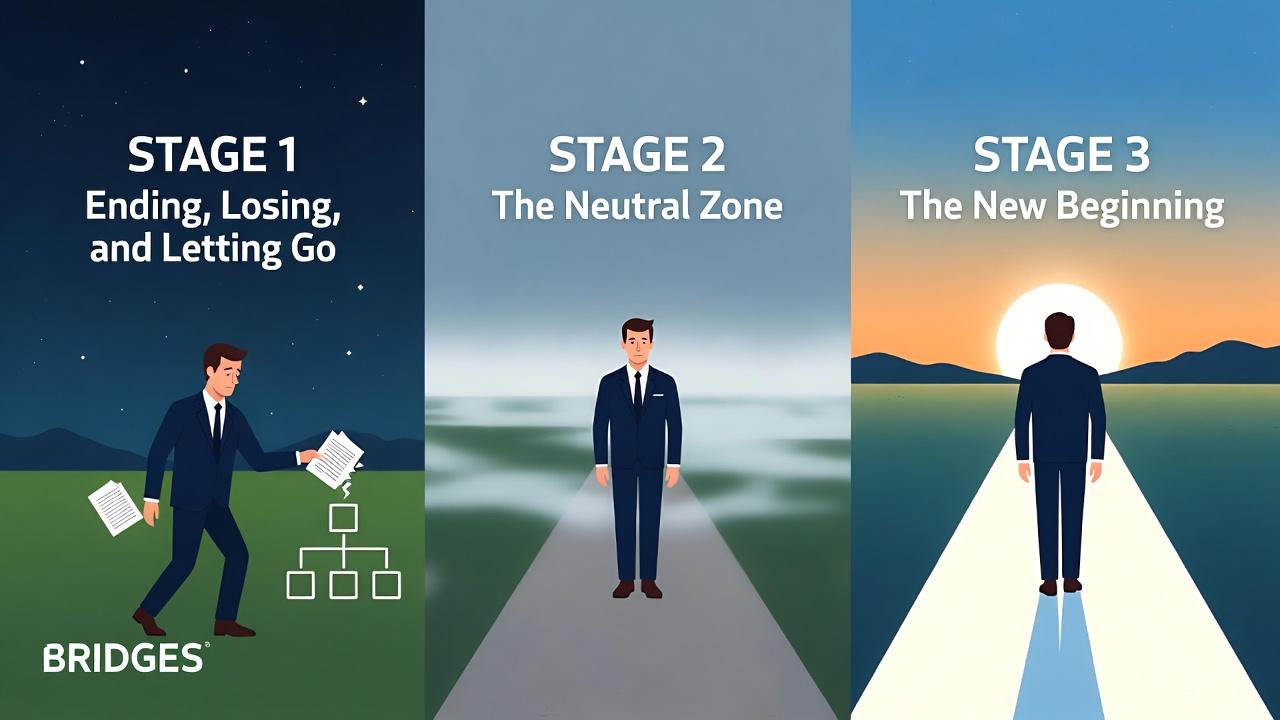
Most change management models focus on what the organisation needs to do — create urgency, form coalitions, implement new systems, embed new processes. William Bridges took a fundamentally different approach. He argued that the real challenge of change isn't the external implementation; it's the internal psychological transition that people go through in response to it. Get the transition right, and the change succeeds. Ignore it, and even the best-planned change will struggle.
This distinction — between change and transition — is at the heart of Bridges' model and makes it uniquely valuable for people professionals. Change is situational: a new reporting structure, a different HRIS, a merger with another company. Transition is psychological: letting go of how things were, navigating uncertainty, and eventually embracing something new. An organisation can implement change on a specific date, but transition happens on its own timeline, and that timeline is different for every individual.
The Three Phases of Transition
Phase 1: Endings
This is the most counterintuitive aspect of Bridges' model. Every transition begins not with something new, but with an ending. Before people can move forward, they must let go of what came before.
Endings involve loss, and loss provokes grief. This isn't dramatic language — it's a psychological reality. When an organisation restructures, people lose familiar routines, established working relationships, known competencies, and sometimes their sense of professional identity. A team leader whose team is dissolved hasn't just lost a role; they've lost the relationships, the expertise, and the status that came with it. Telling them to "focus on the exciting opportunities ahead" dismisses a genuine experience of loss.
The losses people experience during organisational change include:
Loss of identity. People define themselves partly through their work roles. "I'm the person who runs the Birmingham office" or "I'm the expert on the old system" — when those roles disappear, people lose part of how they understand themselves professionally.
Loss of competence. People who were highly skilled under the old way of working may feel like beginners under the new. A finance professional who mastered complex spreadsheet processes now faces an automated system that makes their hard-won expertise feel obsolete. This isn't just about learning a new tool; it's about moving from expert to novice, which threatens self-esteem.
Loss of relationships. Restructures break up teams. People who worked together effectively, who trusted each other, who had informal support networks, suddenly find themselves working with strangers. These relationships took years to build and can't be instantly replicated.
Loss of certainty. Even imperfect situations are familiar. People know what to expect, how to navigate the politics, where to find what they need. Change replaces this certainty with unknowns, which creates anxiety regardless of whether the change is objectively beneficial.
How to Manage Endings
Bridges argued that managers and HR professionals need to acknowledge endings rather than minimise them. This means:
Name what's ending. Be specific about what is changing and what people are losing. Vague announcements create more anxiety than honest ones. If a team is being restructured, say so clearly rather than using euphemisms that leave people guessing.
Acknowledge the loss. Saying "I understand this is difficult" isn't weakness; it's realistic leadership. People don't need managers to fix their feelings, but they do need to feel that their experience is recognised rather than dismissed.
Allow grieving. People need time to process endings. Expecting immediate enthusiasm for a new direction is unrealistic. Some people will adapt quickly; others will need longer. Pressuring people to be positive before they've processed the ending creates resentment rather than buy-in.
Mark the ending. Some organisations find value in explicitly marking transitions — a final team meeting, an acknowledgment of what was achieved under the old structure, a thank you for contributions made. These rituals may seem symbolic, but they provide psychological closure that helps people move forward.
Phase 2: The Neutral Zone
The neutral zone is the most uncomfortable and most important phase of transition. The old way has ended, but the new way hasn't yet taken hold. People exist in an in-between state where old certainties have gone but new ones haven't formed. This is where most change initiatives run into trouble.
The neutral zone is characterised by:
Confusion. People aren't sure what's expected of them. Old rules no longer apply, but new rules haven't been established or haven't been communicated clearly. Decisions that were straightforward under the old system now involve uncertainty.
Anxiety. Without familiar reference points, people feel exposed. Will I be good at this? Will I keep my job? Will this new approach actually work? These aren't irrational fears; they're reasonable responses to genuine uncertainty.
Reduced productivity. People are learning, adjusting, making mistakes, and spending energy on navigating ambiguity rather than performing at their best. Organisations that expect normal productivity during the neutral zone set themselves up for frustration on all sides.
Polarisation. Some people push enthusiastically toward the new; others cling to the old. This creates tension between "early adopters" and "resisters" that can fragment teams if not managed.
Why the Neutral Zone Matters
Despite its discomfort, Bridges argued that the neutral zone is where real transformation happens. Freed from established patterns, people think more creatively. The old rules are suspended, which creates space for innovation. Some of the best ideas emerge during this unsettled period, precisely because the usual constraints have been loosened.
The neutral zone is also where people genuinely internalise change. During the endings phase, people process what they've lost. During the neutral zone, they begin to reimagine what's possible. This internal work is essential — without it, people adopt new behaviours superficially without genuine commitment.
How to Manage the Neutral Zone
Normalise the discomfort. Tell people that confusion and uncertainty are expected parts of the process, not signs that something has gone wrong. When people know the neutral zone is a phase they'll move through, they're better equipped to tolerate it.
Provide structure. Paradoxically, the ambiguity of the neutral zone requires more structure, not less. Clear short-term goals, regular check-ins, temporary processes, and explicit expectations help people navigate when everything else feels uncertain.
Create feedback mechanisms. People in the neutral zone need to know how they're doing. Without feedback, anxiety grows. Regular communication from managers about what's working, what needs adjusting, and what progress has been made keeps people grounded.
Celebrate experiments. People will try new approaches, and some won't work. If mistakes are punished, people retreat to safe, familiar behaviours. If experimentation is encouraged and failures are treated as learning, people engage more willingly with the new.
Protect people from unnecessary additional change. The neutral zone is draining. Piling additional changes on top of an existing transition overwhelms people and extends the period of disruption. Where possible, create stability around the edges while the core transition unfolds.
Phase 3: New Beginnings
New beginnings don't happen on a schedule. They emerge gradually as people develop new competencies, form new relationships, find new sources of meaning, and build confidence in new ways of working. Bridges emphasised that beginnings can't be forced — they happen when people are internally ready, which varies from person to person.
Signs that people are entering new beginnings include:
Renewed energy. People start engaging proactively rather than reactively. They bring ideas, volunteer for projects, and show interest in developing within the new context.
New identity. People begin to define themselves in terms of the new situation rather than the old. "I used to run the Birmingham office" becomes "I'm now leading the regional integration."
Competence and confidence. People feel capable in the new environment. The initial clumsiness of learning new systems and processes gives way to fluency.
Forward-looking perspective. Conversations shift from what was lost to what's possible. People begin planning and anticipating rather than mourning and resisting.
How to Support New Beginnings
Clarify purpose. People need to understand not just what they're doing but why it matters. Connect the new way of working to meaningful goals. If a restructure happened to improve customer service, make sure people can see how their new roles contribute to that outcome.
Provide quick wins. Early successes in the new environment build confidence and reinforce that the change is working. Design work so that people experience small victories that confirm their growing competence.
Reinforce new behaviours. Recognition, reward, and positive feedback for working in the new way help solidify new beginnings. If the change requires collaboration across previously separate teams, celebrate examples of successful cross-team working.
Be patient with uneven progress. Not everyone reaches new beginnings at the same time. Some people will be thriving while others are still in the neutral zone. Avoid creating a narrative of "winners" and "laggards" — people transition at different speeds, and pressure to perform new beginnings before people are ready is counterproductive.
Bridges vs Other Change Models
Understanding where Bridges fits relative to other models helps you use each effectively.
Bridges vs Lewin: Both have three phases, but they focus on different things. Lewin describes the organisational process (unfreeze, change, refreeze). Bridges describes the individual psychological experience (endings, neutral zone, new beginnings). Lewin's unfreezing corresponds roughly to Bridges' endings, but the focus is different — Lewin asks "how do we prepare the organisation for change?" while Bridges asks "what are people going through emotionally?"
Bridges vs Kotter: Kotter provides eight actionable steps for leaders implementing change. Bridges explains what's happening psychologically while those steps are being executed. They work well together — Kotter for planning what to do, Bridges for understanding what people need.
Bridges vs Kubler-Ross: Both focus on emotional responses, but Kubler-Ross describes specific emotions (denial, anger, depression, acceptance) while Bridges describes broader phases of psychological adjustment. The Kubler-Ross curve might explain what someone is feeling; Bridges explains what phase of transition they're in and what support they need.
Using Bridges' Model in CIPD Assignments
Bridges' Transition Model is particularly valuable in CIPD assignments because it centres the people experience — which is what the CIPD profession is about.
Apply it to real situations. Describe a change your organisation has experienced and analyse how people moved through endings, the neutral zone, and new beginnings. Where was support adequate? Where did the organisation overlook the transition process?
Compare it with other models. Don't use Bridges in isolation. Show how it complements Lewin's process focus or Kotter's leadership focus. This comparison demonstrates the analytical depth assessors look for at Level 5.
Discuss practical implications. What would you recommend based on Bridges' model? How would you support people through endings? What structures would you put in place during the neutral zone? These practical recommendations connect theory to HR practice.
Acknowledge limitations. Bridges' model focuses on individual transition but says less about organisational systems and processes. It assumes people move through phases in roughly the same sequence, which isn't always the case. It also offers limited guidance on the operational aspects of change management. Noting these limitations demonstrates critical evaluation.
Link to the psychological contract. Organisational change often breaches the psychological contract — the unwritten expectations employees hold about their employment relationship. Bridges' model helps explain why this breach feels so significant and what organisations can do to rebuild trust during transition. Making this connection between models demonstrates sophisticated thinking.