Lewin's Change Model: Unfreeze, Change, Refreeze Explained for CIPD
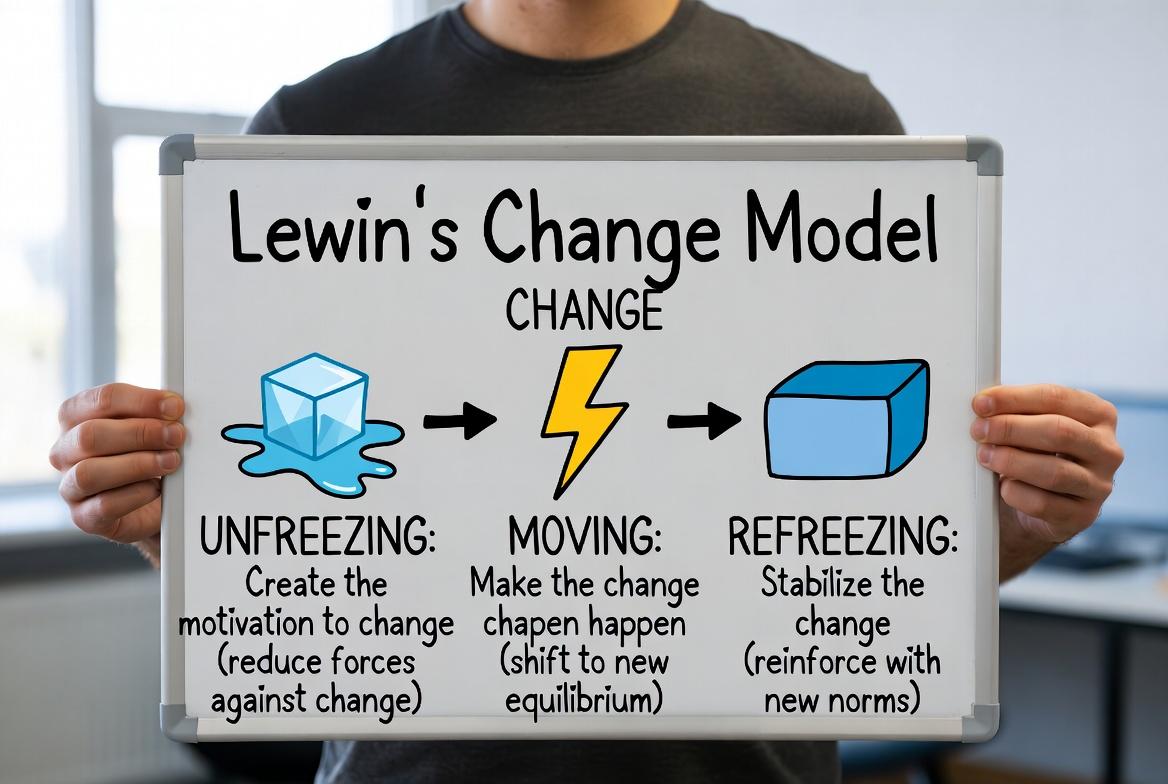
Kurt Lewin developed his three-stage model of change in the 1940s while working as a social psychologist. Despite being over 80 years old, the model remains one of the most influential frameworks for understanding how organisations change—and it appears regularly in CIPD syllabuses, particularly in 5CO01.
The model's enduring appeal lies in its simplicity: it captures the fundamental dynamics of change in three memorable stages. Understanding Lewin thoroughly will help you analyse change scenarios and compare different approaches in your assignments.
Watch the Video: People Study Pro members get free access to our Lewin's Change Model explainer video, plus Kotter, Kübler-Ross, and other change management models. Sign up free →
The Three Stages Explained
Lewin used the metaphor of changing the shape of a block of ice. You can't simply reshape ice—you need to melt it first, mould it into the new shape, then freeze it again. Organisational change works similarly.
Stage 1: Unfreeze
Before change can happen, the current state must be destabilised. People naturally resist change because the status quo feels safe and familiar. Unfreezing means preparing the organisation for change by:
Creating awareness of the need for change
- Communicating why the current state is no longer acceptable
- Sharing data, feedback, or evidence that highlights problems
- Building a compelling case that change is necessary
Challenging existing beliefs and behaviours
- Questioning assumptions about "how we do things here"
- Highlighting the gap between current and desired performance
- Creating discomfort with the status quo
Reducing resistance
- Involving people early to build ownership
- Addressing fears and concerns openly
- Providing support for those who will be affected
Lewin described this as overcoming the "driving forces" (pushing for change) and "restraining forces" (resisting change). His Force Field Analysis tool helps identify and address these forces.
In practice: Before implementing a new performance management system, you would need to show why the current approach isn't working, involve managers in designing the new system, and address concerns about increased workload or unfamiliar technology.
Stage 2: Change (or Transition)
Once people accept that change is needed, the actual transition can begin. This is the implementation phase where new ways of working are introduced. Key elements include:
Implementing new processes, systems, or behaviours
- Rolling out new tools, structures, or procedures
- Training people in new skills
- Establishing new roles or reporting lines
Providing support and guidance
- Coaching and mentoring during the transition
- Clear communication about what's expected
- Resources to help people adapt
Managing the uncertainty
- Acknowledging that transition is uncomfortable
- Celebrating early wins to build momentum
- Adjusting plans based on feedback
This stage is often the most difficult because people are between the old and new ways—the old is no longer acceptable, but the new isn't yet comfortable. Lewin recognised that change takes time and people need support throughout.
In practice: Implementing the new performance management system would involve training sessions, pilot groups, ongoing support from HR, and regular check-ins to address issues as they arise.
Stage 3: Refreeze
The final stage involves stabilising the new state so it becomes the new norm. Without refreezing, there's a risk of sliding back to old habits. Refreezing involves:
Embedding the change into culture
- Updating policies, procedures, and documentation
- Aligning reward and recognition systems
- Making the new way "how things are done"
Reinforcing new behaviours
- Celebrating successes and recognising adopters
- Addressing any remaining resistance
- Ensuring leadership models the new behaviour
Sustaining the change
- Monitoring to ensure the change sticks
- Building new habits and routines
- Removing old systems or processes that could enable regression
In practice: For the new performance system, refreezing would mean updating the employee handbook, training new managers in the approach, linking performance conversations to development and reward decisions, and retiring the old system entirely.
Force Field Analysis
Lewin also developed Force Field Analysis as a practical tool for understanding change dynamics. The concept is simple:
Driving forces: push toward change (e.g., competitive pressure, customer demands, new technology)
Restraining forces: push against change (e.g., fear of unknown, comfort with status quo, lack of skills)
Change happens when driving forces outweigh restraining forces. You can achieve this by:
- Strengthening driving forces (adding pressure for change)
- Weakening restraining forces (removing barriers)
- Doing both
Lewin argued that reducing restraining forces is often more effective than increasing driving forces, because more pressure can create more resistance.
Lewin vs Kotter: How They Compare
Lewin's model and Kotter's 8-Step Model are often compared in CIPD assignments:
Mapping Kotter to Lewin:
Unfreeze: ≈ Kotter steps 1-4 (urgency, coalition, vision, communication)
Change: ≈ Kotter steps 5-7 (empower, quick wins, consolidate)
Refreeze: ≈ Kotter step 8 (anchor in culture)
In assignments, you might use Lewin to explain the fundamental dynamics, then use Kotter for more detailed recommendations.
Criticisms of Lewin's Model
For critical analysis in your assignments, consider these limitations:
Too Linear and Sequential
The model implies change follows a neat sequence, but real change is often messy and iterative. You might be unfreezing in one area while refreezing in another.
The Refreeze Problem
"Refreezing" suggests a new stable state, but modern organisations face continuous change. Some argue we never truly refreeze—we're in a constant state of "slush." This has led to alternative models emphasising continuous adaptation.
Oversimplification
Three stages can't capture the complexity of major organisational transformation. The model doesn't address specific challenges like stakeholder management, resource constraints, or competing priorities.
Limited Attention to Resistance
While Lewin acknowledged resistance, the model doesn't provide detailed strategies for managing it. Emotional and political dimensions of change receive less attention than later models.
Context Matters
The model doesn't account for different types of change (incremental vs transformational) or different organisational contexts (stable vs dynamic industries).
Strengths of Lewin's Model
Despite criticisms, the model endures for good reasons:
Simplicity and Clarity
The three stages are easy to understand and remember, making the model accessible to everyone in an organisation, not just change specialists.
Focus on Preparation
Emphasising "unfreeze" highlights that change fails without proper preparation. Many change initiatives fail because they rush to implementation without building readiness.
Recognition of Stability Needs
While "refreeze" is criticised, it reflects a valid point: change needs to be embedded to stick. Constant change without consolidation leads to "change fatigue."
Foundational Framework
The model provides a foundation that other models build on. Understanding Lewin helps you understand Kotter, ADKAR, and other frameworks.
Applying Lewin in CIPD Assignments
When using Lewin in 5CO01 or other units:
For Analysis
- Use the three stages to structure your analysis of a change scenario
- Identify what needs to be unfrozen (current state, barriers)
- Describe the change implementation approach
- Explain how the change will be sustained
For Critical Evaluation
- Compare Lewin with other models (Kotter, emergent change)
- Discuss limitations in your specific context
- Consider whether "refreeze" is realistic for your organisation
- Evaluate whether the linear approach fits the change scenario
For Recommendations
- Use Force Field Analysis to identify barriers and enablers
- Propose specific activities for each stage
- Suggest how to strengthen driving forces or reduce restraining forces
- Consider what sustained change would look like
Example Application
Scenario: Implementing remote working policy post-pandemic
Unfreeze:
- Communicate data on employee preferences and productivity
- Challenge assumptions that presence equals performance
- Address manager concerns about oversight and control
- Build case for hybrid working as competitive advantage
Change:
- Pilot with willing teams before full rollout
- Train managers in managing remote teams
- Implement new technology for collaboration
- Update policies on expenses, equipment, availability
Refreeze:
- Revise employment contracts to reflect hybrid arrangements
- Update performance management to focus on outcomes
- Redesign office space for collaboration not individual work
- Train new starters in hybrid working expectations
Summary
Lewin's Unfreeze-Change-Refreeze model provides a simple but powerful framework for understanding organisational change:
Unfreeze: — Prepare for change by disrupting the current state
Change: — Implement new ways of working with support
Refreeze: — Stabilise the new state as the norm
The model is best used alongside other frameworks. Its simplicity is both its strength (easy to apply) and weakness (oversimplifies complexity). For CIPD assignments, use Lewin to establish fundamental concepts, then add depth with Kotter or other models for a more complete analysis.