Kubler-Ross Change Curve: Understanding How People Experience Change
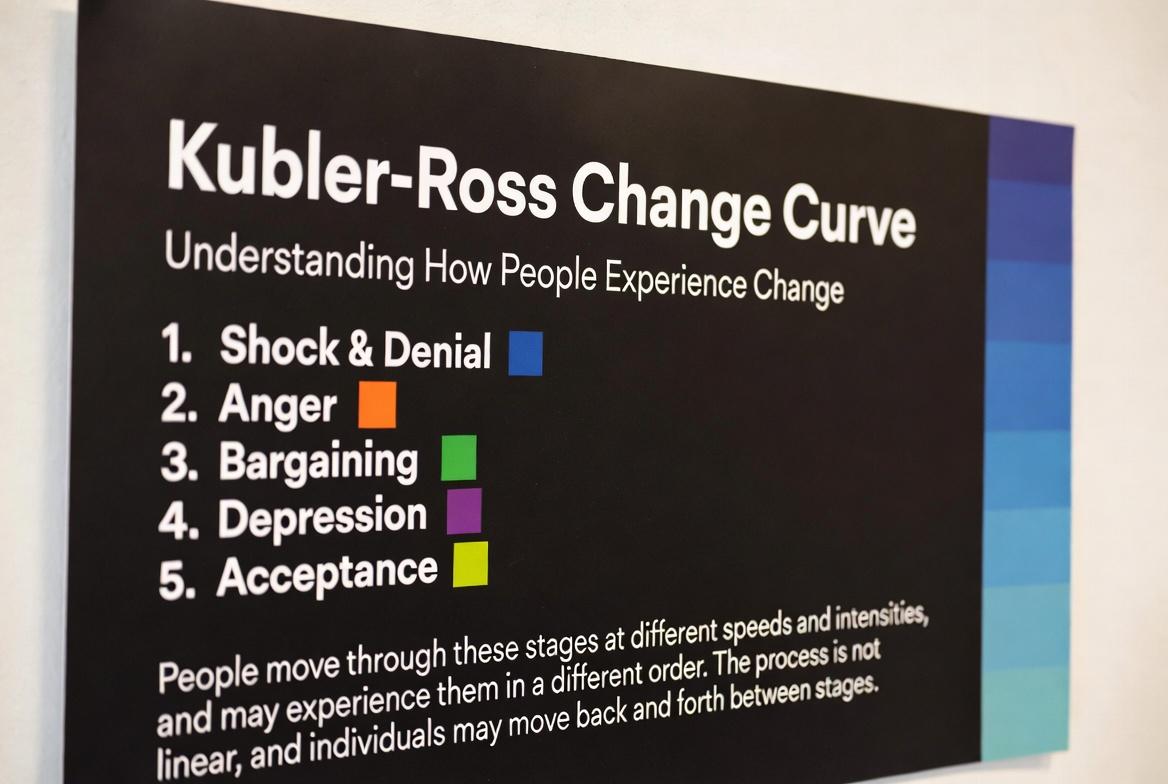
Elisabeth Kubler-Ross originally developed her model in 1969 to describe how people cope with grief and terminal illness. Since then, the model has been widely adapted to explain how people experience any significant change—including organisational change. Understanding this emotional journey is essential for CIPD students, particularly in 5CO01 where you need to discuss "models for how change is experienced."
Watch the Video: People Study Pro members get free access to our Kübler-Ross Change Curve explainer video, plus 20+ other HR model videos. Sign up free →
The Origins
Kubler-Ross was a psychiatrist who studied terminally ill patients. She observed that people moved through predictable emotional stages when facing death. Her book "On Death and Dying" introduced the five stages: denial, anger, bargaining, depression, and acceptance.
Organisational change isn't the same as facing death, but people do experience loss during change—loss of familiar routines, relationships, status, certainty, or identity. The adapted model helps explain the emotional rollercoaster people ride during workplace transitions.
The Change Curve Stages
The organisational version typically includes seven stages, though variations exist:
Stage 1: Shock
What happens: Initial reaction to news of change. People may feel stunned, unable to process information properly.
What you might hear:
- "I can't believe this is happening"
- "This has come out of nowhere"
- Silence or minimal response
What people need:
- Time to absorb the news
- Clear, factual information
- Patience—don't expect immediate engagement
Manager actions:
- Communicate clearly and calmly
- Be available for questions
- Don't expect productivity or enthusiasm yet
Stage 2: Denial
What happens: People refuse to accept the change is real or will affect them. They may carry on as normal, hoping it will go away.
What you might hear:
- "This won't really happen"
- "It won't affect my department"
- "They tried this before and it failed"
- "I'll just keep doing what I've always done"
What people need:
- Repeated, consistent messaging
- Evidence that change is real
- Understanding that denial is a coping mechanism
Manager actions:
- Continue communicating the change
- Gently challenge denial with facts
- Don't force acceptance—let reality sink in
Stage 3: Frustration / Anger
What happens: As reality sets in, emotions emerge. People may feel angry at the organisation, leaders, or themselves. Blame is common.
What you might hear:
- "This is ridiculous"
- "Management never listens"
- "Why wasn't I consulted?"
- "This is going to be a disaster"
What people need:
- Space to express frustration safely
- To feel heard and validated
- Understanding, not dismissal
Manager actions:
- Listen without becoming defensive
- Acknowledge concerns are legitimate
- Don't take anger personally
- Maintain boundaries on behaviour
Stage 4: Depression / Low Point
What happens: The lowest point of the curve. Energy drops, morale falls, productivity suffers. People may feel hopeless or helpless.
What you might hear:
- "What's the point?"
- "I don't know if I can do this"
- "Things will never be the same"
- Withdrawal and disengagement
What people need:
- Emotional support
- Reassurance and encouragement
- Small wins and progress signs
- Connection with others
Manager actions:
- Check in regularly
- Acknowledge the difficulty
- Celebrate small steps forward
- Watch for signs of serious distress
Stage 5: Experiment
What happens: The turning point. People start tentatively engaging with the new reality. They experiment with new ways of working.
What you might hear:
- "Maybe I could try..."
- "How does this work?"
- "Let me see if..."
What people need:
- Permission to try and fail
- Resources and training
- Quick feedback on experiments
- Encouragement
Manager actions:
- Create safe space for experimentation
- Provide learning opportunities
- Celebrate attempts, not just successes
- Remove barriers
Stage 6: Decision
What happens: People make a conscious choice to engage with the change. They commit to making it work.
What you might hear:
- "I'm going to give this a proper go"
- "This could actually be better"
- "I can see the benefits now"
What people need:
- Reinforcement of their decision
- Continued support and resources
- Connection to the bigger picture
- Recognition of progress
Manager actions:
- Acknowledge the commitment
- Provide ongoing support
- Link individual effort to outcomes
- Build on momentum
Stage 7: Integration
What happens: The new way becomes normal. People can't imagine going back. The change is embedded.
What you might hear:
- "This is just how we do things now"
- "I can't believe we used to do it the old way"
- "It's actually better than before"
What people need:
- Recognition of the journey
- Consolidation of new practices
- Continued development
- Readiness for the next change
Manager actions:
- Celebrate success
- Embed new practices formally
- Capture learning
- Prepare for future changes
The Curve Visualised
The change curve follows a predictable pattern over time:
High performance/morale → Shock (sudden drop) → Denial (slight recovery as reality is rejected) → Frustration (decline continues) → Depression (lowest point) → Experiment (gradual improvement begins) → Decision (commitment to change) → Integration (new normal, often higher than before)
The curve resembles a "J" or checkmark shape—performance initially drops below the starting point before eventually recovering and potentially exceeding the original level.
Applying the Model in Practice
For Managers
- Anticipate the curve — Know that people will go through these stages
- Communicate appropriately — Different messages for different stages
- Provide support — Emotional support, not just information
- Be patient — People move at different speeds
- Watch for stuck points — Some need extra help to move forward
For HR/Change Professionals
- Plan for emotions — Include emotional support in change plans
- Train managers — Help them recognise and respond to stages
- Create support structures — Counselling, peer support, regular check-ins
- Monitor progress — Survey, listen, observe where people are
- Adjust timelines — Be realistic about how long integration takes
For Individuals
- Recognise your own journey — Know where you are on the curve
- Accept emotions — They're normal and valid
- Seek support — Talk to managers, colleagues, professionals
- Take small steps — Experiment gradually
- Be patient with yourself — Integration takes time
Comparing Change Models
Use Kubler-Ross alongside process models. Kotter tells you what to do; Kubler-Ross helps you understand how people will respond.
Criticisms and Limitations
Not Linear
People don't move neatly through stages. They may:
- Skip stages
- Move backwards
- Get stuck
- Experience multiple stages simultaneously
- Cycle through repeatedly
Individual Variation
The model assumes a common pattern, but people vary based on:
- Personality
- Previous change experiences
- Nature of the change
- Support available
- Personal circumstances
Oversimplification
Reducing complex emotional experiences to stages can:
- Miss nuance
- Create expectations that people "should" be at certain stages
- Pathologise normal variation
Cultural Assumptions
The model reflects Western assumptions about grief and emotional expression. Different cultures may experience and express emotions differently.
Using Kubler-Ross in CIPD Assignments
For 5CO01 AC 2.4: "Discuss models for how change is experienced"
- Explain the stages and their characteristics
- Discuss what people need at each stage
- Consider implications for change management
- Critically evaluate the model's limitations
- Compare with other models (Tannenbaum & Hanna, Spencer & Adams)
For Critical Analysis
- Acknowledge the model's origins and adaptation
- Discuss the non-linear nature of real experience
- Consider individual and cultural variation
- Evaluate usefulness for HR practice
- Suggest how to use it alongside other models
Practical Example
Scenario: Organisation announces move to hot-desking
Shock: "Wait, we're losing our desks?"
Denial: "My team won't have to do this—we need our setup"
Frustration: "This is about cost-cutting, not collaboration. Management never uses hot-desks"
Depression: "I've lost my photos, my plants, my space. I don't belong anywhere now"
Experiment: "Let me try that quiet pod for focused work... actually, that's pretty good"
Decision: "I'm going to make this work. I'll book the good spots early and keep essentials in my locker"
Integration: "I actually like the variety. I've met people from other teams I never knew before"
Summary
The Kubler-Ross Change Curve helps us understand the emotional journey people experience during organisational change:
- Shock — Stunned, processing
- Denial — Refusing to accept reality
- Frustration — Anger and blame
- Depression — Low point, hopelessness
- Experiment — Tentatively trying new ways
- Decision — Committing to the change
- Integration — New way becomes normal
The model reminds us that change is emotional, not just logical. People need support through the journey, and managers must recognise where individuals are rather than expecting everyone to embrace change immediately.