Employee Engagement Models: What HR Professionals Need to Know
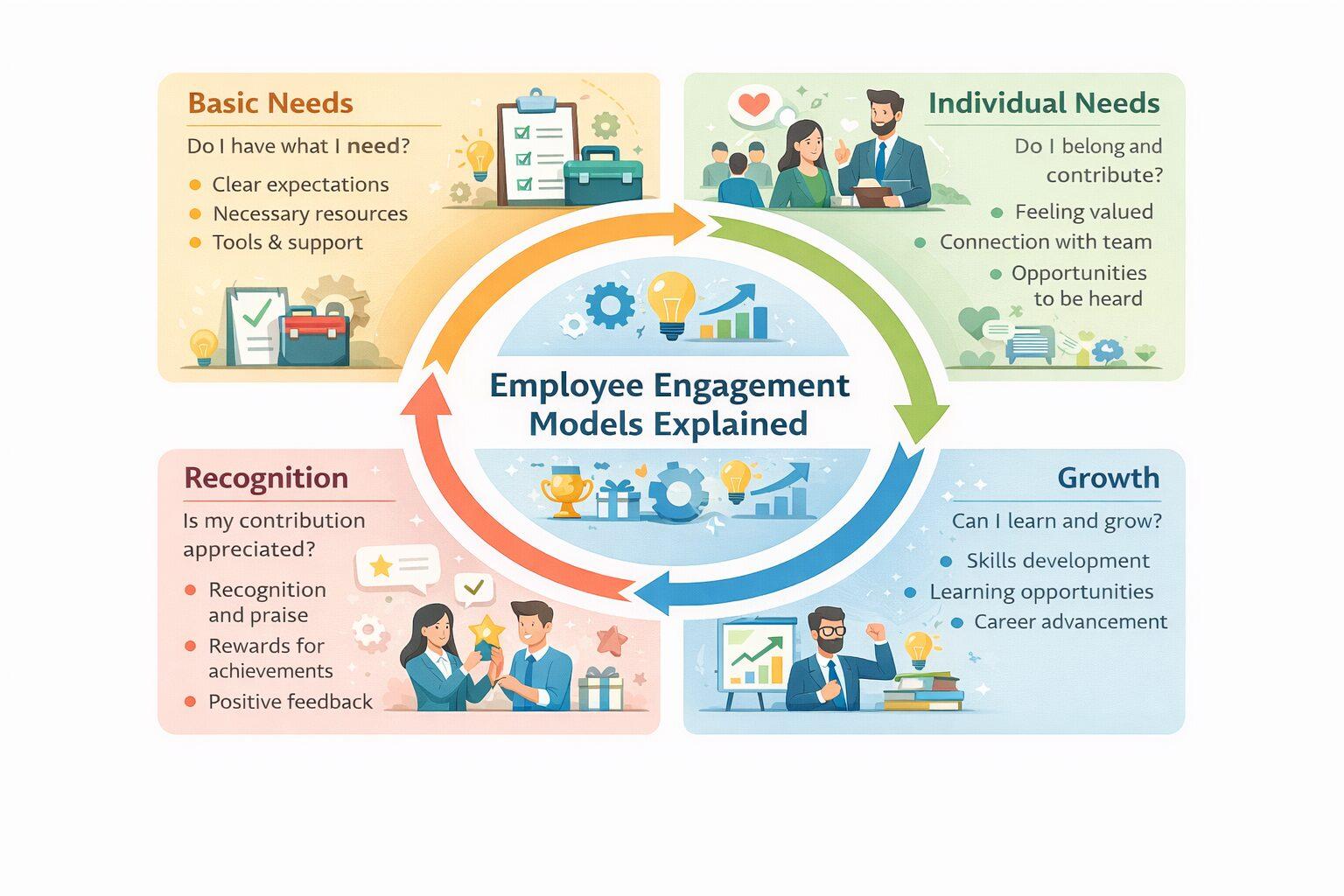
Employee engagement has become one of the most discussed concepts in HR, and for good reason. Research consistently links engagement to outcomes organisations care about — productivity, retention, customer satisfaction, profitability, and innovation. The Engage for Success movement, endorsed by the UK government, identified engagement as a key factor in organisational performance. The CIPD places it at the centre of good people management practice.
Yet engagement remains frustratingly difficult to pin down. Different researchers define it differently, measure it differently, and draw different conclusions about what drives it. For CIPD students, navigating these different perspectives is essential — both for assignments and for practice. This article examines the major engagement models, what they agree on, where they differ, and what they mean for people professionals.
What Is Employee Engagement?
Before examining specific models, it's worth acknowledging that engagement doesn't have a single, universally accepted definition. This matters because how you define engagement determines how you measure it and what you do about it.
At its broadest, engagement describes a state where employees are psychologically present, emotionally connected, and willingly invested in their work and organisation. It goes beyond satisfaction (being content) and beyond motivation (having a reason to try). Engaged employees care about what they do, feel connected to why they do it, and are willing to go beyond minimum requirements because the work itself matters to them.
The CIPD describes engagement as a combination of commitment to the organisation and its values, willingness to help colleagues, and motivation to go the extra mile. This definition emphasises that engagement is active, not passive — it's about what people do, not just how they feel.
Kahn's Model of Personal Engagement
William Kahn published the foundational academic work on engagement in 1990, based on qualitative research with employees in two organisations. Kahn defined engagement as "the harnessing of organisation members' selves to their work roles" — the idea that engaged people bring their full selves (physical, cognitive, and emotional) to their work.
Kahn identified three psychological conditions that must be present for engagement to occur:
Meaningfulness
People engage when they find their work meaningful — when it feels worthwhile, valuable, and significant. Meaningfulness comes from work that is challenging, varied, and allows the use of different skills (connecting directly to Hackman and Oldham's job characteristics). It also comes from roles that carry some status and influence, and from work that contributes to something the individual values.
When work lacks meaningfulness, people withdraw psychologically. They may perform their duties adequately but without genuine investment. The person is present physically but absent mentally and emotionally.
Safety
Psychological safety refers to the feeling that one can express oneself without fear of negative consequences. People engage when they feel safe to be authentic — to share ideas, ask questions, admit mistakes, and express concerns without risking their status, career, or self-image.
Safety is shaped by interpersonal relationships (especially with managers), group dynamics, management style, and organisational norms. In environments where people feel judged, punished for errors, or politically vulnerable, they withdraw into protective self-presentation — doing what's expected but hiding their genuine thoughts and feelings.
This aspect of Kahn's model has gained enormous traction through Amy Edmondson's later work on psychological safety in teams, which has become one of the most influential concepts in contemporary management thinking.
Availability
Availability refers to the physical, emotional, and psychological resources people have to engage at any given moment. Even when work is meaningful and the environment feels safe, engagement requires energy. People who are exhausted, distracted by personal concerns, or overwhelmed by workload may lack the capacity to engage fully.
Availability highlights that engagement isn't solely determined by organisational factors — personal circumstances, health, and life outside work all influence whether someone has the resources to bring their full self to their role. This has become increasingly relevant as conversations about wellbeing, burnout, and work-life balance have moved to the centre of HR practice.
Macey and Schneider's Framework
Macey and Schneider (2008) addressed the confusion around engagement by distinguishing between three forms:
Trait Engagement
Some people have a natural disposition toward engagement. They're inherently positive, proactive, and conscientious — they would be engaged in almost any reasonable work environment. Trait engagement reflects personality characteristics like positive affect, conscientiousness, and proactive personality.
This concept is useful because it acknowledges that individual differences matter. Not all variation in engagement levels is caused by organisational factors — some people are more naturally inclined toward engagement than others. For HR professionals, this means recruitment and selection play a role in engagement levels, not just post-hire interventions.
State Engagement
State engagement is the psychological experience of being engaged — feeling absorbed, energised, and dedicated at a particular point in time. This is what most people mean when they talk about engagement. It's the experience of being fully present and invested in your work.
State engagement fluctuates. The same person might feel highly engaged on a day when they're working on a challenging project with supportive colleagues, and disengaged on a day when they're completing bureaucratic tasks in isolation. Understanding engagement as a state rather than a fixed attribute means organisations should focus on creating conditions that promote engagement consistently rather than expecting it to be constant.
Behavioural Engagement
Behavioural engagement is what engaged people actually do — the observable actions that result from feeling engaged. This includes discretionary effort (going beyond minimum requirements), organisational citizenship behaviours (helping colleagues, contributing to a positive work environment), and proactive behaviours (identifying problems, suggesting improvements, taking initiative).
Macey and Schneider's framework is useful because it clarifies that engagement isn't one thing but three related things. Organisations might hire for trait engagement, create conditions for state engagement, and measure behavioural engagement as an outcome. Confusing these different forms leads to muddled thinking about what engagement is and how to influence it.
The Robinson/IES Model
The Institute for Employment Studies (IES), through the work of Dilys Robinson and colleagues, positioned engagement as fundamentally a two-way relationship between employer and employee. Their research emphasised that engagement is not something organisations do to people — it's something that emerges from a reciprocal exchange.
In this model, the organisation provides meaningful work, good management, development opportunities, voice, and fair treatment. The employee responds with commitment, effort, and positive behaviour. When the exchange breaks down — when the organisation fails to meet its side of the deal — engagement declines.
This reciprocal framing connects engagement directly to the psychological contract. The employer's obligations (interesting work, fair pay, development, respect) and the employee's obligations (effort, loyalty, positive behaviour) form an implicit deal. Engagement flourishes when both sides feel the deal is being honoured and deteriorates when either side perceives a breach.
The Robinson model also identified key drivers of engagement from UK-based research:
Feeling valued and involved: — the most powerful driver, reflecting people's need to feel their contribution matters and their voice is heard
Quality of line management: — direct managers have disproportionate influence on engagement because they mediate the employment experience daily
Communication: — feeling informed about what's happening in the organisation and why decisions are made
Development opportunities: — believing the organisation invests in your growth
Fairness and equity: — perceiving that processes and outcomes are just
The CIPD's Approach to Engagement
The CIPD doesn't endorse a single engagement model but draws on multiple perspectives to identify practical implications for people professionals. Their approach emphasises several themes:
Job Design Matters
Engagement starts with the work itself. Jobs that provide autonomy, variety, meaningful challenges, and clear feedback create the conditions for engagement. This directly reflects Hackman and Oldham's Job Characteristics Model and Kahn's meaningfulness condition. No amount of engagement initiatives can compensate for fundamentally boring, restrictive, or meaningless work.
Management Quality Is Critical
The relationship between an employee and their line manager is the single most influential factor in engagement. Managers who provide clear direction, genuine support, regular feedback, and respectful treatment create the conditions for engagement. Managers who micromanage, withhold information, fail to recognise contributions, or treat people unfairly destroy it.
This has practical implications for HR: investing in management development is one of the highest-return engagement interventions available. Training managers to have effective one-to-one conversations, provide constructive feedback, and support development addresses a root cause of disengagement rather than a symptom.
Voice and Involvement
People engage when they feel heard — when their opinions are sought, their concerns are taken seriously, and they can influence decisions that affect their work. Voice operates at multiple levels: individual voice (being heard by your manager), team voice (contributing to team decisions), and organisational voice (having input into broader strategic direction).
Organisations that make decisions without consulting those affected, that ignore feedback from surveys, or that create channels for voice without actually listening to what's said, undermine engagement through perceived futility.
Organisational Integrity
Engagement depends on trust, and trust depends on integrity — the alignment between what the organisation says and what it does. This connects to Schein's concept of the gap between espoused values and underlying assumptions. When organisations espouse values they don't live by, employees become cynical, and cynicism is the enemy of engagement.
The Engage for Success Framework
The MacLeod and Clarke report to the UK government (2009) identified four enablers of engagement that provide a practical framework:
Strategic narrative — A clear, compelling story about where the organisation is going and why, told by leadership in a way that helps employees see how their role contributes.
Engaging managers — Line managers who focus their people, treat them as individuals, and coach and stretch them.
Employee voice — Employees' views are sought, listened to, and acted upon. They see their input making a difference.
Organisational integrity — Values on the wall are reflected in day-to-day behaviour. There's no say-do gap.
This framework is widely referenced in UK HR practice and provides a useful structure for analysing engagement in CIPD assignments.
Common Misconceptions About Engagement
Engagement Is Not Satisfaction
A satisfied employee is content with their situation — they don't have major complaints. An engaged employee is actively invested in their work and organisation. Satisfaction is passive; engagement is active. People can be satisfied but coasting — doing enough to keep their job without investing discretionary effort. Conversely, engaged employees might be dissatisfied with specific aspects of their employment (pay, for instance) while still being deeply committed to their work and team.
Engagement Is Not Happiness
Happy employees aren't necessarily engaged, and engaged employees aren't necessarily happy in every moment. Engagement involves challenge, effort, and sometimes frustration. A deeply engaged professional working on a difficult project may feel stressed, stretched, and exhausted — but also purposeful, connected, and unwilling to give anything less than their best.
Engagement Is Not the Employee's Responsibility
Framing engagement as something employees should produce — "be more engaged!" — fundamentally misunderstands the concept. Engagement is an outcome of how work is designed, how people are managed, and how the organisation operates. People don't choose to be disengaged any more than they choose to be demotivated. Creating the conditions for engagement is the organisation's responsibility; experiencing engagement is the natural human response to those conditions.
Measuring Engagement
Measurement matters because it provides evidence for diagnosis and intervention, but it requires care.
Surveys remain the most common approach. Validated instruments like the Utrecht Work Engagement Scale (UWES) measure vigour, dedication, and absorption. Organisation-specific surveys measure drivers and outcomes tailored to context. Pulse surveys provide frequent, lightweight data points. Annual surveys provide comprehensive baseline measurement.
Qualitative approaches — stay interviews, focus groups, informal conversations — provide depth that surveys miss. They reveal why people feel the way they do, not just how they feel.
Proxy indicators — absence rates, turnover, productivity, discretionary effort, innovation metrics — provide behavioural evidence that complements attitudinal survey data.
The critical principle is that measurement without action is worse than not measuring at all. When organisations survey engagement and then fail to respond to the results, they demonstrate the very lack of integrity that undermines engagement. People feel their voice has been solicited and ignored — a powerful driver of cynicism.
Using Engagement Models in CIPD Assignments
Compare Multiple Models
Don't rely on a single definition or model. Show that you understand the landscape — Kahn's psychological conditions, Macey and Schneider's trait-state-behaviour distinction, the IES reciprocal model, and the CIPD's practical framework. Compare and evaluate them rather than simply describing one.
Connect to Other Theories
Engagement connects to virtually everything in the CIPD syllabus. Link it to the psychological contract (engagement as a product of a healthy contract), to Hackman and Oldham (job design as an engagement driver), to the AMO model (engagement as an expression of motivated, capable people given opportunity), or to Herzberg (engagement conditions as motivators rather than hygiene factors).
Apply Critically
Engagement has been criticised as a vague concept that means different things to different people, as a management tool that places the burden of organisational performance on individual employees, and as an industry that generates consulting revenue without clear evidence of impact. Engaging with these critiques demonstrates the critical thinking assessors value.
Focus on Practice
What would you actually do to improve engagement in your organisation? Which model best explains the current situation? What interventions address the root causes rather than the symptoms? Practical recommendations grounded in theoretical analysis are what CIPD assessors look for at Level 5 and above.