Honey and Mumford Learning Styles: A Guide for CIPD Students
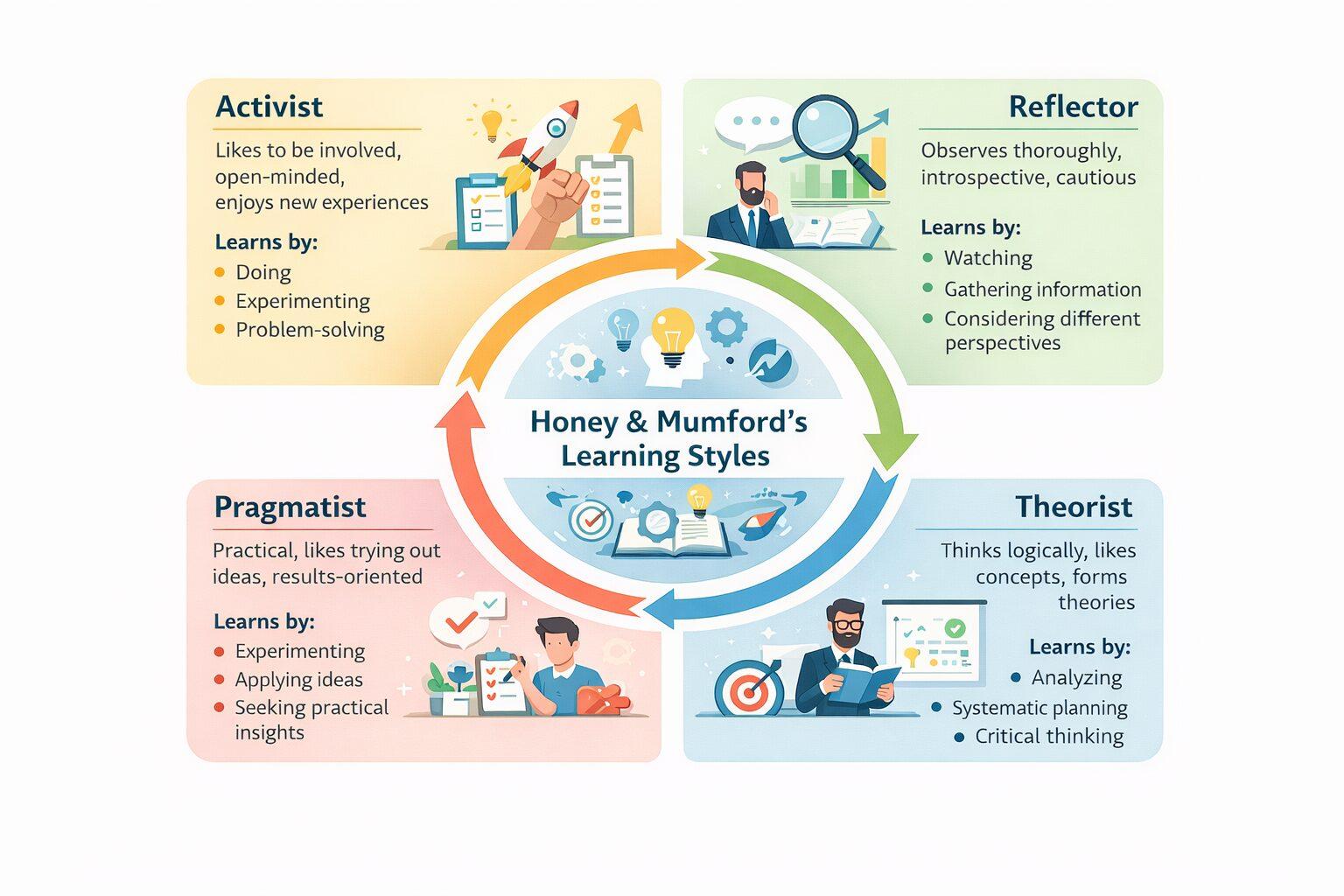
Peter Honey and Alan Mumford developed their learning styles model in the 1980s, building on David Kolb's earlier work on experiential learning. Their contribution was to make the theory more accessible and practically useful for workplace learning and development. Where Kolb described learning as a cognitive process through four stages, Honey and Mumford focused on the observable behavioural preferences people show when they learn. The result is a model that's straightforward to understand, easy to apply, and widely used across L&D practice — though not without controversy.
The core idea is simple: people have preferences about how they learn. Some people learn best by jumping in and trying things. Others prefer to stand back and observe first. Some need to understand the theory before they'll engage. Others only care about practical application. These preferences aren't fixed personality traits — they can be developed and adapted — but they do influence how people respond to different learning opportunities.
The Four Learning Styles
Activist
Activists learn by doing. They thrive on new experiences, enjoy being thrown in at the deep end, and get bored with passive activities like listening to lectures or reading lengthy materials. Activists are enthusiastic, open-minded, and willing to try anything once. They tend to act first and consider the consequences afterwards.
In a training context, Activists engage with group exercises, role plays, simulations, brainstorming sessions, and anything that involves active participation. They struggle with activities that require them to sit still, absorb information passively, or work alone for extended periods. A three-hour lecture with slides will lose an Activist within the first twenty minutes.
Activists' strengths include their willingness to embrace new challenges and their energy in group settings. Their weaknesses include a tendency to rush into things without adequate preparation, to lose interest once the initial novelty fades, and to take unnecessary risks because action feels more comfortable than analysis.
In the workplace, Activists often volunteer for new projects, enjoy leading initiatives, and bring energy to teams. They may struggle with detailed planning, follow-through on routine tasks, and activities that require patience and sustained concentration.
Reflector
Reflectors learn by observing and thinking. They prefer to stand back, gather information from multiple perspectives, and consider all angles before reaching a conclusion. Reflectors are thorough, cautious, and thoughtful. They tend to listen more than they talk in meetings and prefer to observe a new process before attempting it themselves.
In training, Reflectors engage with observation activities, case studies, paired discussions, self-directed research, and any activity that gives them time to think before responding. They struggle when forced to act without preparation, when put on the spot in front of others, or when time pressure prevents them from considering their response carefully.
Reflectors' strengths include their thoroughness, their ability to see multiple perspectives, and the quality of their considered judgements. Their weaknesses include a tendency toward over-analysis, difficulty making decisions when under time pressure, and reluctance to contribute in fast-moving group discussions where they haven't had time to formulate their thoughts.
In the workplace, Reflectors are often the people who send the most thoughtful email responses, ask the best questions in meetings (if given time to think), and produce high-quality analytical work. They may be overlooked in organisations that reward speed and confidence over accuracy and depth.
Theorist
Theorists learn by understanding the underlying principles, models, and frameworks that explain how things work. They need to see the logic behind what they're learning. Disconnected facts and activities without theoretical grounding leave them frustrated. Theorists are analytical, rational, and systematic in their thinking.
In training, Theorists engage with conceptual frameworks, models, structured content, reading, and activities that build understanding from first principles. They enjoy analysing why something works, not just that it works. They struggle with unstructured activities, emotional or subjective content, and anything that seems illogical or theoretically unsound.
Theorists' strengths include their analytical rigour, their ability to integrate new information into existing knowledge frameworks, and the depth of their understanding. Their weaknesses include a tendency to reject ideas that don't fit their existing models, difficulty with ambiguity and uncertainty, and a preference for intellectual engagement over practical application.
In the workplace, Theorists often become subject matter experts whose deep understanding of their domain is invaluable. They may struggle with situations that require rapid adaptation without full understanding, or with colleagues who prefer action to analysis.
Pragmatist
Pragmatists learn by applying ideas to real-world situations. They're interested in theory only insofar as it helps them do something better. Pragmatists are practical, down-to-earth, and focused on results. Their constant question is "how can I use this?"
In training, Pragmatists engage with case studies linked to real situations, practical exercises with clear workplace relevance, action planning, and problem-solving activities. They struggle with purely theoretical content, abstract discussions that seem disconnected from practice, and training that doesn't offer clear takeaways they can implement immediately.
Pragmatists' strengths include their ability to translate learning into action, their focus on practical outcomes, and their impatience with anything that doesn't add value. Their weaknesses include a tendency to dismiss ideas that don't have immediate practical application (even when they might be valuable long-term), difficulty with theoretical depth, and a narrow focus on what works now rather than why it works.
In the workplace, Pragmatists are often the people who return from training and immediately try to implement what they've learned. They're valued for their results orientation but may need encouragement to engage with deeper conceptual thinking that doesn't have obvious immediate application.
The Connection to Kolb
Honey and Mumford's four styles map directly onto Kolb's four stages of experiential learning:
Kolb described learning as a cycle through all four stages — experiencing, reflecting, conceptualising, and experimenting. Honey and Mumford's contribution was recognising that while effective learning requires all four stages, most people have a natural preference for one or two stages over others. These preferences are their learning styles.
The implication is that effective learners develop capability across all four styles rather than relying exclusively on their preferred approach. An Activist who never reflects misses important lessons from experience. A Theorist who never experiments fails to test their understanding against reality. A Reflector who never acts accumulates observations without impact. A Pragmatist who never theorises applies solutions without understanding why they work.
Implications for L&D Practice
Training Design
The most common application of Honey and Mumford's model is in designing training programmes that accommodate all four styles. Effective training includes:
For Activists: Hands-on exercises, group work, role plays, simulations, competitions, and variety. Keep activities short and energetic. Minimise passive content.
For Reflectors: Time for observation and thinking, paired discussions, journals, pre-reading, and activities where they can process information before responding. Don't force immediate responses.
For Theorists: Conceptual frameworks, models, structured presentations, reading material, and logical explanations of why things work the way they do. Provide the intellectual foundation.
For Pragmatists: Case studies with practical relevance, action planning, problem-solving exercises, and explicit connections between theory and workplace application. Answer the "so what?" question.
Good training doesn't design separate tracks for each style — that's impractical and often unnecessary. Instead, it builds variety into the programme so that every learner encounters some activities suited to their preference and some that stretch them into less comfortable territory. This variety also prevents any single group from disengaging for too long.
Individual Development
Helping individuals understand their learning preferences empowers them to manage their own development more effectively. A Reflector who knows they need thinking time can ask for pre-reading before a workshop. A Pragmatist who knows they need practical relevance can focus on action planning after theoretical input. An Activist who knows they lose concentration during lectures can take notes or ask questions to stay engaged.
Self-awareness about learning preferences also helps people recognise their blind spots. Encouraging Activists to build in reflection, Reflectors to take action, Theorists to experiment, and Pragmatists to engage with underlying principles develops more rounded learners.
Coaching and Mentoring
Understanding a coachee's or mentee's learning preferences helps the coach adapt their approach. A Reflector benefits from guided questioning that allows them to explore their own thinking. An Activist benefits from challenging assignments that push them into new experiences. A Theorist benefits from recommended reading and frameworks. A Pragmatist benefits from practical problem-solving and immediate application.
The Controversy Around Learning Styles
CIPD students should be aware that learning styles models — including Honey and Mumford's — have attracted significant scientific criticism. This debate is important for academic credibility and for demonstrating critical engagement with theory.
The core critique, supported by extensive research, is that while people report preferences for how they learn, there is limited evidence that matching teaching methods to preferred styles actually improves learning outcomes. Several systematic reviews have concluded that the "matching hypothesis" — the idea that Activists learn better from activist-style activities — is not supported by robust evidence.
Critics argue that learning styles models oversimplify the learning process, that preferences reported on questionnaires don't reliably predict learning behaviour, and that resources spent on identifying and accommodating individual styles would be better spent on evidence-based teaching methods that benefit all learners.
Why the Model Persists
Despite these criticisms, Honey and Mumford's model remains widely used in L&D practice. Several reasons explain this persistence:
It encourages variety. Even if the matching hypothesis is unproven, designing training that includes different types of activities benefits all learners by maintaining engagement and approaching content from multiple angles.
It promotes self-awareness. Reflecting on how you learn is valuable regardless of whether the four-style framework is scientifically precise. People who think about their learning approach tend to learn more deliberately.
It provides shared language. The model gives teams a vocabulary for discussing different contributions and preferences. This is practically useful even if the underlying science is debated.
It's accessible. Compared to more complex learning theories, Honey and Mumford's model is easy to understand and apply. This accessibility has driven its adoption in organisations where theoretical precision is less important than practical utility.
Using Honey and Mumford in CIPD Assignments
When writing about learning styles in CIPD assignments, balance is essential. The model is useful but imperfect, and assessors expect you to demonstrate awareness of both its practical value and its limitations.
Describe the model accurately. Explain the four styles and their characteristics, showing you understand what each involves. This demonstrates knowledge.
Apply it practically. Show how you'd use the model in a real L&D context — designing a training programme, supporting individual development, or analysing why a learning intervention succeeded or failed. This demonstrates application.
Engage with the criticism. Acknowledge the scientific debate about learning styles. Don't dismiss the model, but don't treat it as unquestionable truth either. The mature position is: "Learning preferences exist and are worth considering, but the evidence for matching teaching to styles is limited, and the model should be one input among many in L&D design."
Connect to other frameworks. Link Honey and Mumford to Kolb's experiential learning cycle (their theoretical foundation), to the 70:20:10 model (different types of learning), or to the CPD cycle (identifying how individuals prefer to learn during the planning stage). These connections demonstrate breadth and integration.
Consider alternatives. If the assignment allows, discuss alternative approaches to understanding how adults learn — Knowles' andragogy, neuroscience-informed approaches, or social learning theory. Showing awareness of the broader landscape demonstrates intellectual depth beyond a single model.