Schein's Three Levels of Organisational Culture Explained
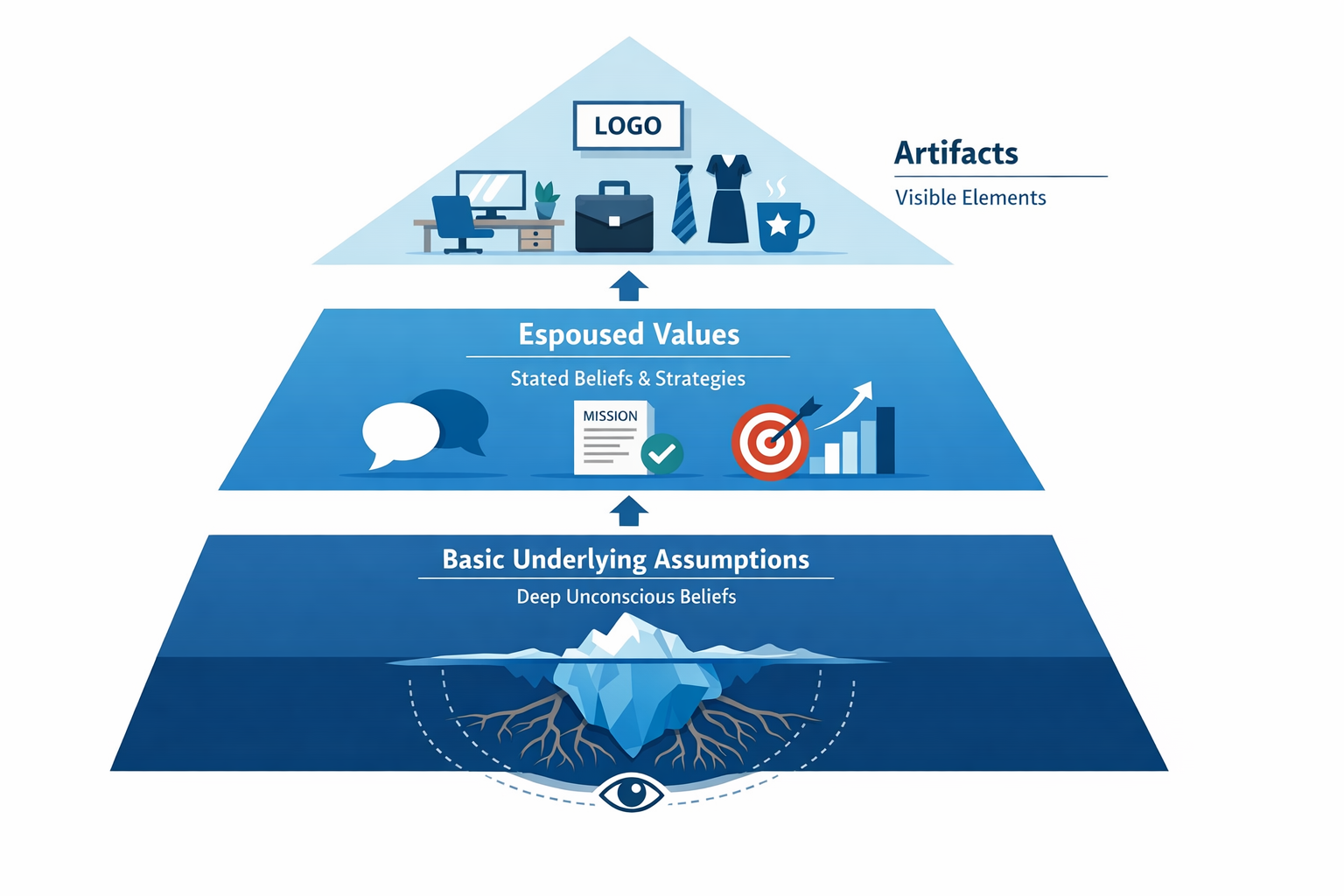
Edgar Schein, one of the most influential thinkers in organisational psychology, argued that culture is the most difficult organisational attribute to change — more resistant than strategy, structure, or systems. His model, first published in 1985 and refined over subsequent decades, explains why. Culture operates at three distinct levels, and most of what drives behaviour sits beneath the surface, invisible to casual observation and resistant to direct intervention.
Understanding Schein's model is essential for CIPD students because organisational culture appears across multiple units, particularly 5CO01 (Organisational Performance and Culture in Practice). More importantly, it equips people professionals with a framework for analysing culture that goes beyond the superficial — beyond the ping-pong tables and values posters that many organisations mistake for culture.
Level 1: Artefacts
Artefacts are the visible, tangible, audible elements of an organisation's culture. They're what you notice immediately when you walk into an organisation or visit its website. Artefacts include:
Physical environment — Office layout, building design, technology, furnishings. An open-plan office with collaborative spaces signals something different from private offices arranged by seniority. A reception area with awards and achievement displays tells a different story from one featuring community projects and employee artwork.
Language and jargon — How people communicate, the terminology they use, the stories they tell. Organisations where people speak in acronyms and technical jargon create a different cultural experience from those where plain language is the norm. The stories people tell — about founders, about crises survived, about heroes and villains — reveal cultural values even when they're told casually.
Rituals and ceremonies — How meetings are conducted, how success is celebrated, how people are welcomed and how they leave. An organisation that holds elaborate recognition ceremonies values public achievement. One that marks departures with genuine appreciation values loyalty and relationships. One that does neither may have a more transactional culture.
Dress code — What people wear and how strictly it's enforced. Formal business dress in a professional services firm, casual wear in a tech startup, uniforms in a manufacturing plant — each reflects and reinforces cultural expectations about professionalism, hierarchy, and belonging.
Published documents — Mission statements, annual reports, websites, internal communications. These are deliberate cultural artefacts — the organisation's attempt to project its identity.
The Problem with Artefacts
Artefacts are easy to observe but difficult to interpret accurately. An open-plan office might indicate a collaborative culture — or it might indicate a cost-cutting culture that's dressed up as collaboration. A values poster proclaiming "People are our greatest asset" might reflect genuine commitment — or it might be corporate wallpaper that nobody takes seriously.
Schein warned against reading too much into artefacts without understanding the deeper levels of culture. Artefacts are symptoms, not causes. Changing the office layout doesn't change the culture any more than changing a patient's thermometer reading changes their temperature. Yet many culture change programmes focus almost entirely on artefacts — rebranding, redesigning offices, launching new communication platforms — because artefacts are visible and changeable. The deeper levels are harder to access.
Level 2: Espoused Values
Espoused values are the principles, norms, and ethical rules that the organisation says it follows. They're more abstract than artefacts and represent the organisation's stated beliefs about what's important and how things should be done.
Espoused values typically appear in:
Mission and values statements — "We value integrity, innovation, and inclusion." These are the organisation's official position on what it stands for.
Strategies and goals — "Our strategy is to be the employer of choice in our sector." This reflects stated beliefs about what the organisation should prioritise.
Policies and procedures — Formal rules about how decisions should be made, how people should be treated, and what behaviours are expected. A grievance policy reflects espoused values about fairness. A flexible working policy reflects espoused values about trust and work-life balance.
Leadership rhetoric — What senior leaders say in town halls, communications, and one-to-one conversations. When a CEO repeatedly emphasises customer service, they're expressing an espoused value.
The Gap Between Espoused Values and Reality
Schein's critical insight was that espoused values don't always match actual behaviour. An organisation might espouse teamwork while its reward systems incentivise individual competition. It might espouse innovation while punishing failure. It might espouse diversity while its leadership team is homogeneous.
This gap between what organisations say and what they do is one of the most important things for people professionals to understand. Employee cynicism, disengagement, and distrust often stem from perceived hypocrisy — the organisation says one thing but does another. New employees are particularly vulnerable; they join based on the espoused values communicated during recruitment, then discover a different reality through daily experience.
When espoused values and actual behaviour align, culture is strong and coherent. When they don't, culture is fragmented and trust erodes. One of the most valuable things an HR professional can do is honestly assess the gap between espoused values and lived reality, and work to close it.
Level 3: Basic Underlying Assumptions
Basic underlying assumptions are the deepest level of culture — the unconscious, taken-for-granted beliefs that truly drive behaviour. They're so deeply embedded that people don't question them, and may not even be aware of them. They're "the way things are done around here" at its most fundamental.
Underlying assumptions include beliefs about:
Human nature — Are people fundamentally trustworthy or do they need to be monitored? An organisation that assumes people are honest will design systems based on trust and exception handling. One that assumes people will cheat will design systems based on surveillance and control. These assumptions shape everything from expense policies to working-from-home arrangements.
The nature of truth — How does the organisation determine what's correct? Through data and evidence? Through the opinion of senior leaders? Through consensus? Through tradition? These assumptions shape how decisions are made, whose voices matter, and how disagreements are resolved.
Relationships and hierarchy — Is the organisation fundamentally hierarchical or egalitarian? Are decisions made by those with authority or by those with expertise? Can junior employees challenge senior ones? These assumptions, often unspoken, determine how power operates in practice regardless of the official structure.
Time orientation — Does the organisation focus on the past (tradition, precedent), the present (current performance, immediate results), or the future (innovation, long-term strategy)? This assumption shapes planning horizons, investment decisions, and how the organisation responds to change.
The environment — Does the organisation see itself as controlling its environment or responding to it? Is the external world a threat to be defended against or an opportunity to be embraced? These assumptions shape strategic orientation and risk appetite.
Why Assumptions Are So Powerful
Underlying assumptions are powerful precisely because they're invisible. When everyone in an organisation shares the same assumptions, those assumptions feel like reality rather than choices. An organisation where the underlying assumption is "senior leaders know best" doesn't experience this as a cultural belief — it experiences it as obvious common sense. Challenging the assumption feels not just wrong but absurd.
This invisibility makes assumptions extremely difficult to change. You can redesign the office (artefact), rewrite the values statement (espoused value), and even change policies and procedures — but if the underlying assumptions remain the same, behaviour reverts to old patterns once the change initiative loses momentum.
Schein argued that cultural change is essentially the process of surfacing, examining, and deliberately altering underlying assumptions. This is slow, uncomfortable, and often met with resistance — not because people are stubborn, but because their assumptions feel like fundamental truths rather than beliefs that could be different.
Analysing Culture Using Schein's Model
The practical value of Schein's model lies in using the three levels as a diagnostic framework. Here's how:
Start with artefacts. Observe what's visible. What does the physical environment tell you? What language do people use? What stories are told? How are meetings run? What gets celebrated? These observations generate hypotheses about the culture.
Examine espoused values. Read the mission statement, policies, and strategic documents. Listen to what leaders say. Compare these espoused values with the artefacts you've observed. Are they consistent? An organisation that espouses collaboration but has private offices, individual bonuses, and competitive internal rankings has a gap between levels one and two.
Probe underlying assumptions. This is the hardest step. Ask people why things are done the way they are. Listen to the answers — especially the ones that begin with "that's just how things work here" or "it's obvious that..." These responses indicate assumptions so deep they feel like facts. Pay attention to what happens when someone challenges the status quo — the intensity of the reaction often reveals how deeply an assumption is held.
Identify alignment and gaps. The most useful output of this analysis is understanding where the three levels align and where they don't. An organisation whose artefacts, espoused values, and underlying assumptions all point in the same direction has a strong, coherent culture. One where the levels contradict each other has a culture problem that no amount of surface-level intervention will fix.
Schein and Change Management
Schein's model has profound implications for organisational change. It explains why so many change initiatives fail — they target the wrong level of culture.
Changing artefacts (redesigning offices, launching new systems, updating branding) is relatively easy but produces little lasting change if espoused values and assumptions remain the same. People return to old behaviours once the novelty wears off.
Changing espoused values (rewriting mission statements, launching new policies, communicating new priorities) is harder but still insufficient if underlying assumptions remain untouched. People will pay lip service to new values while continuing to behave according to old assumptions.
Changing underlying assumptions is where real cultural transformation happens, but it requires making the invisible visible — bringing unconscious beliefs to the surface, examining them critically, and deliberately developing new ones. This connects to Lewin's concept of unfreezing — creating the psychological conditions where people are willing to question what they've always taken for granted.
This is slow, difficult work. It typically requires sustained leadership commitment over years rather than months. It demands honest conversations that many organisations avoid. And it often meets resistance because challenging someone's basic assumptions feels like challenging their identity, not just their habits.
Schein vs Other Culture Models
Schein vs Handy: Charles Handy identified four types of organisational culture — power, role, task, and person. Handy's model categorises cultures into types; Schein's model analyses the depth and structure of any culture. They're complementary — you might use Handy to identify what type of culture exists and Schein to understand why it persists and how to change it.
Schein vs Johnson and Scholes Cultural Web: The Cultural Web identifies six interrelated elements that make up the "paradigm" of an organisation. Like Schein, it aims to surface the deeply held beliefs that drive behaviour. The Cultural Web is often more practical as a diagnostic tool in workshops; Schein's model provides the theoretical depth that explains why the elements identified in the Cultural Web are so resistant to change.
Using Schein in CIPD Assignments
Schein's model is particularly valuable in CIPD assignments on organisational culture, especially in 5CO01.
Go beyond description. Don't just list the three levels — apply them to a real organisation. Describe specific artefacts you've observed, identify stated espoused values, and analyse what you believe the underlying assumptions are. This applied analysis is what assessors want to see.
Identify the gaps. The most insightful analysis explores where the three levels don't align. If your organisation espouses innovation but the underlying assumption is that mistakes are punished, articulate this tension and discuss its consequences. This demonstrates critical thinking.
Connect to change. If the assignment addresses organisational change or culture change, use Schein to explain why surface-level interventions are insufficient and what deeper work is required. This demonstrates sophisticated understanding of how culture operates.
Acknowledge complexity. Note that organisations rarely have a single, uniform culture. Subcultures exist across departments, teams, locations, and hierarchical levels. Schein's model applies at these sub-levels too. Recognising this complexity demonstrates analytical maturity.
Pair with other models. Using Schein alongside Handy's cultural typology, the Cultural Web, or change management models like Lewin shows your ability to integrate multiple frameworks. Assessors at Level 5 expect this kind of synthesis.